


Congo. Democratic Republic of the
Power & telecom standards in Congo. Democratic Republic of the
Connectivity Overview
Tempest Telecom offered dial-up internet access, WiFi hotspot access and broadband ethernet access in Congo. Democratic Republic of the. We also offered Iridium satellite Internet and Voice access in Congo. Democratic Republic of the for communications in rural areas without infrastructure.
Congo. Democratic Republic of the uses 220V at 50Hz. Power outlets are type C, D, E and telephone jacks are RJ-11.
Dial-up Internet Access
Tempest Telecom provided local dial-up access numbers in Congo. Democratic Republic of the at $0.255/minute. Travelers could connect using any standard modem with an RJ-11 telephone adapter.
WiFi Hotspot Access
Tempest Telecom provided WiFi hotspot access in Congo. Democratic Republic of the at $19.95/day for unlimited browsing.
Adapters & Power
Travelers from North America will need a power plug adapter. European Type C/F adapters are widely compatible.
Standard RJ-11 jacks are used. Most international modems will connect without an adapter.
Congo. Democratic Republic of the at a Glance
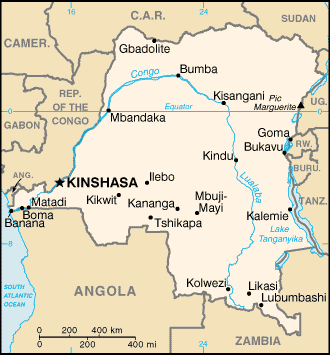
- Capital
- Kinshasa
- Phone Code
- +243
- Voltage
- 220V / 50Hz
- Power Plug
- C, D, E
- Phone Jack
- RJ-11
- Currency
- Franc
- Dial-up
- $0.255/min
- WiFi
- $19.95/day
About connectivity in Congo. Democratic Republic of the
The Democratic Republic of the Congo uses 220V/50Hz with Type C, Type D, and Type E outlets — a mix reflecting layered Belgian colonial-era wiring (Type C/E) and modern European-standard installations across the post-Mobutu reconstruction. The phone jack is RJ-11. The Congolese telecom sector was reconstructed almost from scratch following the country's 1990s-2000s civil wars; the post-2000 mobile-led rebuild has been transformative. The mobile market is dominated by Vodacom Congo (Vodafone-affiliated), Orange RDC (the post-2016 acquisition of Tigo), and Airtel Congo.
DRC commercial Internet emerged in the late 1990s through limited ISP operations, with very low penetration through the 2000s due to fixed-line infrastructure limitations and the country's vast territory (the second-largest country in Africa by area, with poor internal connectivity). Mobile data has driven essentially all recent Congolese Internet-access growth; the country's 3G/4G rollout from the 2010s onward dramatically expanded urban connectivity, though rural coverage remains limited across the Congo Basin rainforest interior. The 2009 arrival of the WACS underwater fiber-optic cable substantially expanded Atlantic-coast international bandwidth.
Congolese cardphone deployment was limited. The Congolese prepaid international calling-card market through the 2000s and 2010s served the substantial Congolese diaspora — concentrated in Belgium (the historic Belgian colonial-era community, particularly in Brussels-Matonge and Antwerp; Belgium hosts one of the largest Congolese populations outside Congo), France (Paris-Château-Rouge district), the United Kingdom, South Africa, the United States, and across the broader Central African Community refugee circuit. Card brands targeting Lingala-, Swahili-, Kikongo-, and French-language destinations sold through African-grocery networks in the receiving countries.
Tempest Telecom served the Democratic Republic of the Congo through dial-up POPs in Kinshasa. The Congo Basin rainforest expedition customer base, the eastern provinces' mining sector (the cobalt, copper, and coltan operations in Katanga and the Kivu provinces), the very substantial NGO and humanitarian customer base across the recurring conflict zones in the east (the Goma humanitarian hub through multiple crisis periods), and broadcast journalists covering the country's long-running civil and security crises all sustained Iridium and BGAN customer demand. The DRC's scale, terrain, and political environment made it one of the most concentrated satellite-phone markets in Sub-Saharan Africa.
Modern DRC has expanding mobile-data coverage with 4G LTE in major cities (Kinshasa, Lubumbashi, Goma, Bukavu); FTTH is concentrated in Kinshasa. The country's vast geographic scale and ongoing security challenges in the eastern provinces continue to constrain broader infrastructure development.
Tempest's services across Congo. Democratic Republic of the, 1997–2012
Tempest Telecommunications operated international connectivity services in Congo. Democratic Republic of the between 1997 and 2012 under a unified prepaid account that absorbed multiple service types onto a single customer credential. Customers in Congo. Democratic Republic of the drew from the same balance for pre-paid international voice calling, RADIUS-authenticated dial-up Internet roaming, metered Wi-Fi hotspot access, Iridium and Thuraya satellite voice, and Inmarsat BGAN and Thuraya data terminals. The PATN kiosk-card clearinghouse (Tempest's TITAN kiOSK, incorporated 2000) extended the same card-and-PIN model to public Internet terminals but did not reach scale.
Both Iridium (global LEO) and Thuraya (regional GEO) satellite voice were available in Congo. Democratic Republic of the from approximately 2001, alongside global BGAN data from late 2005.
Nearby countries in Africa
Central African Republic · Chad · Comoros · Congo · Djibouti · Egypt · Equatorial Guinea · Eritrea