


Indonesia
Power & telecom standards in Indonesia
Connectivity Overview
Tempest Telecom offered dial-up internet access, WiFi hotspot access and broadband ethernet access in Indonesia. We also offered Iridium satellite Internet and Voice access in Indonesia for communications in rural areas without infrastructure.
Indonesia uses 230V at 50Hz. Power outlets are type C, F and telephone jacks are RJ-11.
Dial-up Internet Access
Tempest Telecom provided local dial-up access numbers in Indonesia at $0.155/minute. Travelers could connect using any standard modem with an RJ-11 telephone adapter.
WiFi Hotspot Access
Tempest Telecom provided WiFi hotspot access in Indonesia at $19.95/day for unlimited browsing.
Adapters & Power
Travelers from North America will need a power plug adapter. European Type C/F adapters are widely compatible.
Standard RJ-11 jacks are used. Most international modems will connect without an adapter.
Indonesia at a Glance
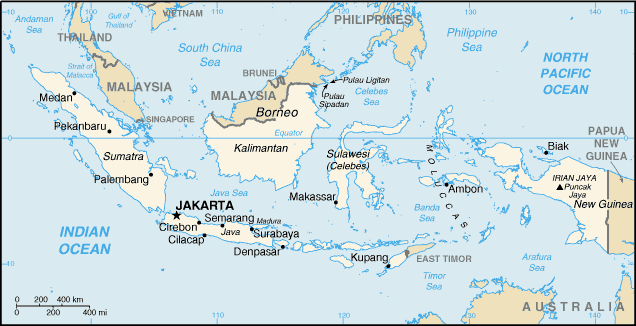
- Capital
- Jakarta
- Phone Code
- +62
- Voltage
- 230V / 50Hz
- Power Plug
- C, F
- Phone Jack
- RJ-11
- Currency
- Rupiah
- Dial-up
- $0.155/min
- WiFi
- $19.95/day
About connectivity in Indonesia
Indonesia uses 230V/50Hz with Type C and Type F outlets — a legacy of Dutch colonial wiring practice continued through the post-independence Indonesian standard. The phone jack is RJ-11. Telkom Indonesia (founded 1856 under Dutch colonial administration, post-1991 corporatized) and Indosat (founded 1967) historically dominated the fixed and international markets respectively, before partial privatizations and consolidations. The mobile market is dominated by Telkomsel (Telkom's mobile arm), Indosat Ooredoo Hutchison (the post-2022 merger of Indosat and 3 Indonesia), and XL Axiata.
Indonesia's academic IPTEKnet network opened the country's first international Internet connection in 1993-1994. Commercial dial-up began in 1995-1996 with IndoNet (one of the earliest), RadNet, Cabinet (Cable Internet), and Telkom Indonesia's TelkomNet Instan service. Per-minute metered dial-up through Telkom PSTN dominated the late 1990s. The 1997-1998 Asian financial crisis and the Reformasi political transition slowed Indonesian Internet investment for several years. ADSL service rolled out from Telkom Speedy in 2004 and broadband adoption accelerated through the 2010s; mobile data dominates Indonesian Internet access today, with 4G LTE covering the populated parts of the archipelago and 5G rolling out in major cities since 2021.
Telkom Indonesia introduced cardphone units in the 1990s with chip-card technology becoming standard. The Indonesian prepaid international calling-card market through the late 1990s and 2000s served the substantial Indonesian outbound migrant-labor populations — an estimated 9+ million Indonesians work abroad at any given time, concentrated in Malaysia, Saudi Arabia, the UAE, Hong Kong, Taiwan, Singapore, and South Korea (Indonesian domestic helpers and construction workers are major migrant-labor populations in those receiving countries). Card brands targeting Indonesian destinations sold through neighborhood shops in the labor-receiving countries. Telkom payphone fleets across the major Indonesian cities have been progressively decommissioned through the 2010s.
Tempest Telecom served Indonesia through dial-up POPs in Jakarta, Surabaya, Medan, Bandung, and Denpasar (Bali). The Indonesian archipelago's 17,000+ islands made the country a meaningful Iridium satphone market — maritime industries across the Malacca Strait, Java Sea, and Banda Sea, oil-and-gas operations in Sumatra and Kalimantan, expedition crews in Papua and Sulawesi, and tourism operators across the remote-island markets all sustained satellite-voice and BGAN data demand.
Modern Indonesia has aggressive 4G LTE rollout to populated areas, with 5G concentrated in Jakarta, Surabaya, and the major cities. FTTH from Telkom IndiHome, FirstMedia, and challenger operators is expanding rapidly in metropolitan areas.
Tempest's services across Indonesia, 1997–2012
Tempest Telecommunications operated international connectivity services in Indonesia between 1997 and 2012 under a unified prepaid account that absorbed multiple service types onto a single customer credential. Customers in Indonesia drew from the same balance for pre-paid international voice calling, RADIUS-authenticated dial-up Internet roaming, metered Wi-Fi hotspot access, Iridium and Thuraya satellite voice, and Inmarsat BGAN and Thuraya data terminals. The PATN kiosk-card clearinghouse (Tempest's TITAN kiOSK, incorporated 2000) extended the same card-and-PIN model to public Internet terminals but did not reach scale.
Both Iridium (global LEO) and Thuraya (regional GEO) satellite voice were available in Indonesia from approximately 2001, alongside global BGAN data from late 2005.
Nearby countries in Asia
East Timor · Georgia · Hong Kong · India · Japan · Kazakhstan · Korea. South · Kyrgyzstan