


Papua New Guinea
Power & telecom standards in Papua New Guinea
Connectivity Overview
Tempest Telecom offered dial-up internet access, WiFi hotspot access and broadband ethernet access in Papua New Guinea. We also offered Iridium satellite Internet and Voice access in Papua New Guinea for communications in rural areas without infrastructure.
Papua New Guinea uses 240V at 50Hz. Power outlets are type I and telephone jacks are RJ-11.
Dial-up Internet Access
Tempest Telecom provided local dial-up access numbers in Papua New Guinea at $0.155/minute. Travelers could connect using any standard modem with an RJ-11 telephone adapter.
WiFi Hotspot Access
Tempest Telecom provided WiFi hotspot access in Papua New Guinea at $19.95/day for unlimited browsing.
Adapters & Power
Travelers from North America will need a power plug adapter. European Type C/F adapters are widely compatible.
Standard RJ-11 jacks are used. Most international modems will connect without an adapter.
Papua New Guinea at a Glance
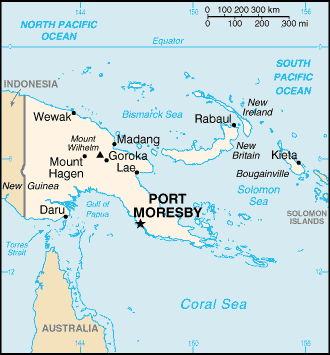
- Capital
- Port Moresby
- Phone Code
- +675
- Voltage
- 240V / 50Hz
- Power Plug
- I
- Phone Jack
- RJ-11
- Currency
- Kina
- Dial-up
- $0.155/min
- WiFi
- $19.95/day
About connectivity in Papua New Guinea
Papua New Guinea uses 240V/50Hz with the Type I plug shared with Australia — reflecting the country's post-1975 independence from Australian administrative oversight. The phone jack is RJ-11. Telikom PNG (state) and Digicel PNG, Vodafone PNG compete in the country's telecom market.
Papua New Guinean commercial Internet emerged in the late 1990s through Telikom PNG. The country's extreme topography (the world's most linguistically diverse country with 800+ languages, spread across rugged mountainous terrain) and modest economic resources have constrained sustained infrastructure investment. Mobile data dominates current access.
The Papua New Guinean prepaid international calling-card market through the 2000s served the modest outbound diaspora — concentrated in Australia (the historic colonial-era and post-independence destination), Solomon Islands, and Fiji.
Tempest Telecom served Papua New Guinea through dial-up POPs in Port Moresby. The substantial mining sector (Ok Tedi, Porgera operations), the LNG sector (the ExxonMobil PNG LNG operations), the Bougainville post-conflict customer base, and the rugged-terrain expedition operators all sustained substantial Iridium and BGAN customer demand.
Modern PNG has expanding 4G LTE coverage in populated areas with FTTH concentrated in Port Moresby; the country's topography continues to make satellite supplemental coverage important.
Tempest's services across Papua New Guinea, 1997–2012
Tempest Telecommunications operated international connectivity services in Papua New Guinea between 1997 and 2012 under a unified prepaid account that absorbed multiple service types onto a single customer credential. Customers in Papua New Guinea drew from the same balance for pre-paid international voice calling, RADIUS-authenticated dial-up Internet roaming, metered Wi-Fi hotspot access, Iridium satellite voice, and Inmarsat BGAN data terminals. The PATN kiosk-card clearinghouse (Tempest's TITAN kiOSK, incorporated 2000) extended the same card-and-PIN model to public Internet terminals but did not reach scale.
Iridium satellite voice was available in Papua New Guinea from approximately 2001 (post-bankruptcy relaunch). Thuraya coverage did not extend to Papua New Guinea; Inmarsat BGAN data terminals filled the broadband gap from late 2005.
Nearby countries in Oceania
Marshall Islands · Micronesia · Nauru · New Caledonia · New Zealand · Solomon Islands · Tonga · Vanuatu