


Senegal
Power & telecom standards in Senegal
Connectivity Overview
Tempest Telecom offered satellite-only service in Senegal. Iridium satellite Internet and Voice access was available for communications in rural areas without infrastructure.
Senegal uses 230V at 50Hz. Power outlets are type C, D, E, K and telephone jacks are RJ-11.
Dial-up Internet Access
Dial-up access was not available in Senegal. Satellite Internet was the recommended alternative.
WiFi Hotspot Access
WiFi hotspot access was not available through Tempest in Senegal.
Adapters & Power
Travelers from North America will need a power plug adapter. European Type C/F adapters are widely compatible.
Standard RJ-11 jacks are used. Most international modems will connect without an adapter.
Senegal at a Glance
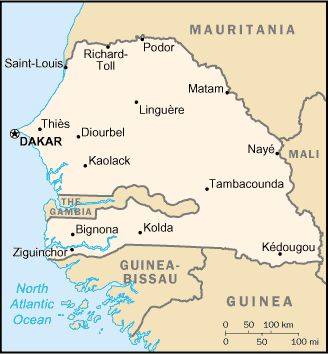
- Capital
- Dakar
- Phone Code
- +221
- Voltage
- 230V / 50Hz
- Power Plug
- C, D, E, K
- Phone Jack
- RJ-11
- Currency
- CFA Franc
- Dial-up
- N/A
- WiFi
- N/A
About connectivity in Senegal
Senegal uses 230V/50Hz with Type C, Type D, Type E, and Type K outlets — an unusual four-type mix reflecting layered French (Type C/E), British (Type D), and Danish-standard (Type K) installations across different infrastructure eras. The phone jack is RJ-11. Sonatel, the post-1985 corporatized successor to the Senegalese postal-telecom operations, was partially privatized in 1997 with France Télécom (now Orange) taking a controlling stake. The Sonatel-Orange brand dominates fixed and mobile markets, with Free Sénégal (the former Tigo, rebranded after 2018 acquisition) and Expresso (Sudatel-owned) competing.
Senegal's academic Internet connectivity began in 1996 through Sonatel, which opened the country's first international gateway. Commercial dial-up emerged the same year with Sonatel's consumer service plus several regional ISPs. Per-minute metered access through Sonatel PSTN dominated the late 1990s. The 2002 arrival of the SAT-3/WASC underwater fiber-optic cable made Senegal one of the earlier West African countries with significant international bandwidth; ADSL rolled out from Sonatel in the early-to-mid 2000s. Mobile data has driven essentially all of Senegal's recent Internet-access growth; the country has also become a notable regional hub for fintech and mobile-money services across West Africa.
Sonatel introduced cardphone units in the 1990s with chip-card cardphones following French-standard chip-card technology. The Senegalese prepaid international calling-card market through the 1990s, 2000s, and 2010s served the substantial Senegalese diaspora — concentrated in France (the largest Senegalese community outside Senegal, particularly in the Paris and Marseille regions), Italy, Spain, the United States (with notable communities in New York, Brooklyn, the DC Metropolitan Area, and Cincinnati), and the broader West African ECOWAS regional labor circuit.
Tempest Telecom served Senegal through dial-up POPs in Dakar — the city is West Africa's historic telecommunications gateway and served as a regional Tempest distribution hub for satellite-phone customers across Mali, Mauritania, Guinea, Gambia, Guinea-Bissau, Cape Verde, and Burkina Faso. Iridium satphones served the Atlantic-coast maritime industry (the Dakar port), Sahel humanitarian operations, archaeological-research operators across the Île de Gorée UNESCO heritage site, and expedition crews supporting Sahara crossings.
Modern Senegal has expanding 4G LTE coverage with 5G rollout beginning in major cities; FTTH from Sonatel-Orange is concentrated in Dakar and the regional centers.
Tempest's services across Senegal, 1997–2012
Tempest Telecommunications operated international connectivity services in Senegal between 1997 and 2012 under a unified prepaid account that absorbed multiple service types onto a single customer credential. Customers in Senegal drew from the same balance for pre-paid international voice calling, RADIUS-authenticated dial-up Internet roaming, metered Wi-Fi hotspot access, Iridium and Thuraya satellite voice, and Inmarsat BGAN and Thuraya data terminals. The PATN kiosk-card clearinghouse (Tempest's TITAN kiOSK, incorporated 2000) extended the same card-and-PIN model to public Internet terminals but did not reach scale.
Both Iridium (global LEO) and Thuraya (regional GEO) satellite voice were available in Senegal from approximately 2001, alongside global BGAN data from late 2005.
Nearby countries in Africa
Niger · Nigeria · Reunion Island · Rwanda · Seychelles · Sierra Leone · Somalia · South Africa