


Italy
Power & telecom standards in Italy
Connectivity Overview
Tempest Telecom offered dial-up internet access, WiFi hotspot access, toll-free dial-up access and broadband ethernet access in Italy. We also offered Iridium satellite Internet and Voice access in Italy for communications in rural areas without infrastructure.
Italy uses 230V at 50Hz. Power outlets are type C, F, L and telephone jacks are RJ-11 / Italian.
Dial-up Internet Access
Tempest Telecom provided local dial-up access numbers in Italy at $0.115/minute. Toll-free numbers were also available at $.17/minute. Travelers could connect using any standard modem with an RJ-11 telephone adapter.
WiFi Hotspot Access
Tempest Telecom provided WiFi hotspot access in Italy at $19.95/day for unlimited browsing.
Adapters & Power
Travelers from North America will need a power plug adapter. European Type C/F adapters are widely compatible.
A RJ-11 / Italian to RJ-11 adapter may be required for connecting a standard modem.
Italy at a Glance
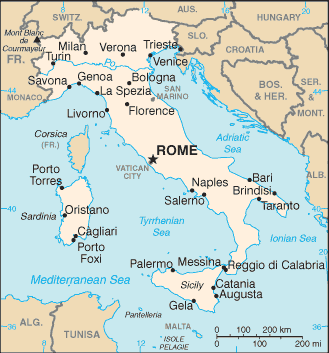
- Capital
- Rome
- Phone Code
- +39
- Voltage
- 230V / 50Hz
- Power Plug
- C, F, L
- Phone Jack
- RJ-11 / Italian
- Currency
- Euro
- Dial-up
- $0.115/min
- WiFi
- $19.95/day
About connectivity in Italy
Italy uses 230V/50Hz with Type C, Type F, and Type L (CEI 23-50) outlets. The Italian "tripolar" telephone connector — distinctive for its three-pin layout — has been largely replaced by RJ-11 in modern installations. SIP (Società Italiana per l'Esercizio Telefonico) became Telecom Italia in 1994, was privatized in 1997, and now operates as TIM alongside competitors Vodafone Italia, WindTre, Fastweb, and Iliad Italia.
Italy's dial-up Internet market took shape in the mid-1990s with Telecom Italia's Tin.it (1996, eventually folded into Alice), Italia Online (the Mediaset-backed portal-ISP combo), and Telecom Italia's ADSL precursor offerings. The disruptor was Tiscali, founded in Cagliari, Sardinia in 1998 by Renato Soru — one of the first European ISPs to push aggressive flat-rate pricing, expanding from Sardinia across mainland Italy and into France, Germany, the Netherlands, and the UK over the early 2000s. Libero (Wind's consumer brand), Virgilio (Telecom Italia's portal), and a long tail of regional ISPs competed through the dial-up years. ADSL rolled out from 2001-2002 and consumer dial-up collapsed across the mid-2000s.
SIP introduced one of Europe's earliest public-payphone card systems in 1976, the magnetic-stripe scheda telefonica. Italian cards had a distinctive anti-fraud feature: a notched corner on the card had to be physically broken off before first use, both proving the card had been activated and preventing kiosk-side fraud. Cards were issued in standard denominations (initially Lire 5,000 and Lire 10,000; later Euro 5 and Euro 10) and SIP / Telecom Italia produced thousands of commemorative editions over three decades, with Italian phonecard collecting becoming a substantial hobby market. Chip-card cardphones gradually superseded magnetic-stripe units through the 1990s and 2000s. Italy was an enormous prepaid international calling-card market through the late 1990s and 2000s, driven by sustained inbound migration from Albania, Romania, Morocco, the Philippines, and South America — private card brands competed with Telecom Italia's own offerings in newsagents and tobacconists (tabacchi) nationwide. The Telecom Italia public payphone network has been almost entirely decommissioned since the mid-2010s.
Tempest Telecom offered metered dial-up access through POPs in Rome, Milan, Naples, Turin, and Florence, plus WiFi hotspot access at $19.95/day as airports and high-end hotel chains deployed wireless networks. Iridium satphones and BGAN terminals served Italian customers in the Alpine north and the maritime/cruise industry sailing the Mediterranean and Adriatic — all integrated into the same unified prepaid platform Tempest had built starting in 1997.
Modern Italy has solid FTTC coverage in urban areas; FTTH rollout has been slower than France or Germany but is accelerating under the national broadband plan and Open Fiber's wholesale network. Iconic SIP/Telecom Italia public payphones — once on every Italian street — have been almost entirely decommissioned.
Tempest's services across Italy, 1997–2012
Tempest Telecommunications operated international connectivity services in Italy between 1997 and 2012 under a unified prepaid account that absorbed multiple service types onto a single customer credential. Customers in Italy drew from the same balance for pre-paid international voice calling, RADIUS-authenticated dial-up Internet roaming, metered Wi-Fi hotspot access, Iridium satellite voice, and Inmarsat BGAN data terminals. The PATN kiosk-card clearinghouse (Tempest's TITAN kiOSK, incorporated 2000) extended the same card-and-PIN model to public Internet terminals but did not reach scale.
Iridium satellite voice was available in Italy from approximately 2001 (post-bankruptcy relaunch). Thuraya coverage did not extend to Italy; Inmarsat BGAN data terminals filled the broadband gap from late 2005.
Nearby countries in Europe
Greece · Hungary · Iceland · Ireland · Latvia · Liechtenstein · Lithuania · Luxembourg