

Latvia
Power & telecom standards in Latvia
Connectivity Overview
Tempest Telecom offered dial-up internet access, WiFi hotspot access and broadband ethernet access in Latvia. We also offered Iridium satellite Internet and Voice access in Latvia for communications in rural areas without infrastructure.
Latvia uses 230V at 50Hz. Power outlets are type C, F and telephone jacks are RJ-11.
Dial-up Internet Access
Tempest Telecom provided local dial-up access numbers in Latvia at $0.155/minute. Travelers could connect using any standard modem with an RJ-11 telephone adapter.
WiFi Hotspot Access
Tempest Telecom provided WiFi hotspot access in Latvia at $19.95/day for unlimited browsing.
Adapters & Power
Travelers from North America will need a power plug adapter. European Type C/F adapters are widely compatible.
Standard RJ-11 jacks are used. Most international modems will connect without an adapter.
Latvia at a Glance
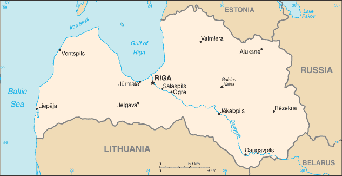
- Capital
- Riga
- Phone Code
- +371
- Voltage
- 230V / 50Hz
- Power Plug
- C, F
- Phone Jack
- RJ-11
- Currency
- Euro
- Dial-up
- $0.155/min
- WiFi
- $19.95/day
About connectivity in Latvia
Latvia uses 230V/50Hz with Type C and Type F outlets. The phone jack is RJ-11. Lattelecom, the post-1991 successor to the Latvian SSR PTT operations, was rebranded Tet in 2018. LMT (Latvijas Mobilais Telefons, founded 1991) was one of the earliest GSM operators anywhere in the former Soviet Union; Tele2 Latvia and Bite Latvia compete in mobile and broadband.
Latvia's academic LATNET network provided early Internet connectivity from 1992. Commercial dial-up began through 1994-1996 with Lattelekom's consumer service, Apollo (Latvijas Tirdzniecibas Banka's ISP), TENET, and several regional providers. Per-minute metered dial-up through Lattelekom PSTN dominated the late 1990s. ADSL rollout from Lattelekom began in 2002, and broadband adoption accelerated through the EU-pre-accession period (Latvia joined the EU in 2004). The Baltic countries collectively have ranked in the European top tier for broadband penetration and digital-skills metrics since the mid-2000s.
Lattelekom introduced cardphone units in the mid-1990s with chip-card cardphones becoming standard. The Latvian commemorative phonecard collector market was substantial through the cardphone era. The prepaid international calling-card market through the 2000s and 2010s served the very large Latvian outbound diaspora — the post-2004 EU-accession Latvian migration to Ireland, the UK, Germany, the Netherlands, and the Nordic countries was proportionally one of the largest such outflows in the EU (Latvia's resident population fell from ~2.4 million in 2000 to ~1.9 million by 2020 largely due to outward migration). The Russian-speaking minority calling Russia also drove substantial cross-border card volume. Tet payphone fleets across Riga, Daugavpils, Liepāja, and Jelgava have been progressively decommissioned through the 2010s.
Tempest Telecom served Latvia through dial-up POPs in Riga. Baltic maritime industry, the Latvian ports of Riga, Liepāja, and Ventspils, and the broader cross-Baltic ferry-route logistics customer base were a meaningful Iridium satphone market.
Modern Latvia has near-universal FTTH coverage in Riga and the regional centers plus mature 4G LTE / 5G nationally. The country consistently ranks in the European top tier for broadband speed and access.
Tempest's services across Latvia, 1997–2012
Tempest Telecommunications operated international connectivity services in Latvia between 1997 and 2012 under a unified prepaid account that absorbed multiple service types onto a single customer credential. Customers in Latvia drew from the same balance for pre-paid international voice calling, RADIUS-authenticated dial-up Internet roaming, metered Wi-Fi hotspot access, Iridium satellite voice, and Inmarsat BGAN data terminals. The PATN kiosk-card clearinghouse (Tempest's TITAN kiOSK, incorporated 2000) extended the same card-and-PIN model to public Internet terminals but did not reach scale.
Iridium satellite voice was available in Latvia from approximately 2001 (post-bankruptcy relaunch). Thuraya coverage did not extend to Latvia; Inmarsat BGAN data terminals filled the broadband gap from late 2005.
Nearby countries in Europe
Hungary · Iceland · Ireland · Italy · Liechtenstein · Lithuania · Luxembourg · Macedonia