


Iceland
Power & telecom standards in Iceland
Connectivity Overview
Tempest Telecom offered dial-up internet access, WiFi hotspot access and broadband ethernet access in Iceland. We also offered Iridium satellite Internet and Voice access in Iceland for communications in rural areas without infrastructure.
Iceland uses 230V at 50Hz. Power outlets are type C, F and telephone jacks are RJ-11.
Dial-up Internet Access
Tempest Telecom provided local dial-up access numbers in Iceland at $0.155/minute. Travelers could connect using any standard modem with an RJ-11 telephone adapter.
WiFi Hotspot Access
Tempest Telecom provided WiFi hotspot access in Iceland at $19.95/day for unlimited browsing.
Adapters & Power
Travelers from North America will need a power plug adapter. European Type C/F adapters are widely compatible.
Standard RJ-11 jacks are used. Most international modems will connect without an adapter.
Iceland at a Glance
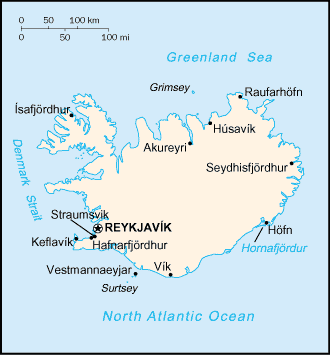
- Capital
- Reykjavik
- Phone Code
- +354
- Voltage
- 230V / 50Hz
- Power Plug
- C, F
- Phone Jack
- RJ-11
- Currency
- Krona
- Dial-up
- $0.155/min
- WiFi
- $19.95/day
About connectivity in Iceland
Iceland uses 230V/50Hz with Type C and Type F outlets. The phone jack is RJ-11. Síminn (formerly Landssími Íslands, the state monopoly), corporatized in 1998 and partially privatized in 2005, remains the dominant operator. Nova (the post-2007 challenger), Vodafone Iceland (owned by Sýn), and Hringdu compete in mobile and broadband.
Iceland's academic SURIS network opened the country's first international Internet connection in 1989, making Iceland one of the earliest non-US Internet nodes. Commercial dial-up emerged through the mid-1990s with Treknet, Margmiðlun, and Síminn's consumer service. The country's small population (under 400,000 residents) and concentrated urbanization in the Reykjavík Capital Region meant broadband rollout was relatively fast once ADSL launched in the early 2000s. Iceland is consistently in the OECD top tier for broadband penetration and the country's undersea fiber connections (FARICE, DANICE, and the IRIS cable launched 2022) keep latency to Europe and North America low.
Síminn introduced cardphone units in the late 1980s with chip-card technology following in the 1990s. The Icelandic prepaid card market was small in absolute volume but produced substantial commemorative collector issues over three decades. The country's historic outbound emigration to Denmark, the US (particularly North Dakota, Minnesota, and Manitoba), and Canada generated some calling-card demand, but Iceland's low population and high mobile-penetration rates kept the prepaid international calling-card market modest compared to most European peers. Síminn payphones across Reykjavík and the regional centers have been almost entirely decommissioned through the 2010s.
Tempest Telecom served Iceland through dial-up POPs in Reykjavík. The North Atlantic fishing industry, the geological-survey and volcanic-monitoring research stations, and the broader Arctic-research customer base were a sustained Iridium satphone market. BGAN terminals supported media coverage of the country's frequent volcanic events (Eyjafjallajökull 2010, Bardarbunga 2014, the Reykjanes peninsula sequences from 2021 onward).
Modern Iceland has near-universal gigabit FTTH coverage in Reykjavík and the regional centers plus mature 4G LTE / 5G nationally. The country's renewable-energy-powered data-center industry attracts hyperscale workloads.
Tempest's services across Iceland, 1997–2012
Tempest Telecommunications operated international connectivity services in Iceland between 1997 and 2012 under a unified prepaid account that absorbed multiple service types onto a single customer credential. Customers in Iceland drew from the same balance for pre-paid international voice calling, RADIUS-authenticated dial-up Internet roaming, metered Wi-Fi hotspot access, Iridium satellite voice, and Inmarsat BGAN data terminals. The PATN kiosk-card clearinghouse (Tempest's TITAN kiOSK, incorporated 2000) extended the same card-and-PIN model to public Internet terminals but did not reach scale.
Iridium satellite voice was available in Iceland from approximately 2001 (post-bankruptcy relaunch). Thuraya coverage did not extend to Iceland; Inmarsat BGAN data terminals filled the broadband gap from late 2005.
Nearby countries in Europe
Germany · Gibraltar · Greece · Hungary · Ireland · Italy · Latvia · Liechtenstein