


Austria
Power & telecom standards in Austria
Connectivity Overview
Tempest Telecom offered dial-up internet access, WiFi hotspot access, toll-free dial-up access and broadband ethernet access in Austria. We also offered Iridium satellite Internet and Voice access in Austria for communications in rural areas without infrastructure.
Austria uses 230V at 50Hz. Power outlets are type C, F and telephone jacks are RJ-11 / Austrian.
Dial-up Internet Access
Tempest Telecom provided local dial-up access numbers in Austria at $0.115/minute. Toll-free numbers were also available at $.17/minute. Travelers could connect using any standard modem with an RJ-11 telephone adapter.
WiFi Hotspot Access
Tempest Telecom provided WiFi hotspot access in Austria at $19.95/day for unlimited browsing.
Adapters & Power
Travelers from North America will need a power plug adapter. European Type C/F adapters are widely compatible.
A RJ-11 / Austrian to RJ-11 adapter may be required for connecting a standard modem.
Austria at a Glance
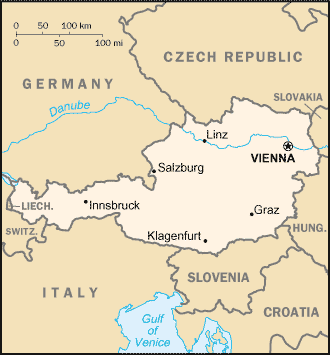
- Capital
- Vienna
- Phone Code
- +43
- Voltage
- 230V / 50Hz
- Power Plug
- C, F
- Phone Jack
- RJ-11 / Austrian
- Currency
- Euro
- Dial-up
- $0.115/min
- WiFi
- $19.95/day
About connectivity in Austria
Austria uses 230V/50Hz with Type C and Type F outlets. The phone jack is RJ-11 in modern installations, with some legacy buildings retaining the Austrian TST connector. Post- und Telekom Austria (PTA) was structurally separated in 1996 and the telecom operations partially privatized as Telekom Austria from 1998 onward; the company was acquired by América Móvil in stages over the 2010s. A1 Telekom Austria (the retail brand), Magenta (formerly T-Mobile Austria, now Deutsche Telekom), and Drei (the Hutchison-owned Three Austria) compete in mobile and broadband.
Austria's academic ACOnet opened the country's first international Internet connection in 1990. Commercial dial-up emerged through 1993-1995 with EUnet Austria, the Post- und Telekom Austria's consumer service (later rebranded Aon), Chello Austria (UPC's cable Internet partnership), Magnet, and a long tail of regional providers. Per-minute metered access over PTA / Telekom Austria PSTN dominated the late 1990s. ADSL rollout from Telekom Austria began in 2000 with the launch of Aon Speed, and cable broadband from UPC competed across the early 2000s. Consumer dial-up faded across the mid-2000s as ADSL coverage saturated the metropolitan and Bundesland centers.
Post- und Telekom Austria introduced its Wertkarte (value card) chip-based phonecard system in the late 1980s, with the distinctive bright-yellow Austrian payphone kiosks rolling out across Vienna, Salzburg, Graz, Linz, and Innsbruck. The Wertkarte became a cultural fixture and developed a substantial commemorative collector market over three decades, with thousands of distinct designs commissioned. The Austrian prepaid international calling-card market through the 2000s served large Turkish, ex-Yugoslav, Polish, Romanian, and Eastern European migrant communities; private card brands competed with Telekom Austria's own products through Trafik kiosks and convenience-store networks. The Telekom Austria payphone fleet has been almost entirely decommissioned since the early 2010s.
Tempest Telecom served Austria through dial-up POPs in Vienna, Salzburg, Graz, and Innsbruck. Vienna's role as a Central European business hub generated sustained business-traveler dial-up roaming demand through the late 1990s and 2000s. The Tyrolean and Salzburg Alps were a strong Iridium satphone market for mountain-rescue, ski-resort operations, and Alpine expedition crews; BGAN terminals supported broadcast coverage of winter sports events.
Modern Austria has dense FTTH coverage in metro areas, with mature 5G from A1 Telekom Austria, Magenta, and Drei. The country is a regular top-tier performer in European broadband-speed and -coverage rankings.
Tempest's services across Austria, 1997–2012
Tempest Telecommunications operated international connectivity services in Austria between 1997 and 2012 under a unified prepaid account that absorbed multiple service types onto a single customer credential. Customers in Austria drew from the same balance for pre-paid international voice calling, RADIUS-authenticated dial-up Internet roaming, metered Wi-Fi hotspot access, Iridium satellite voice, and Inmarsat BGAN data terminals. The PATN kiosk-card clearinghouse (Tempest's TITAN kiOSK, incorporated 2000) extended the same card-and-PIN model to public Internet terminals but did not reach scale.
Iridium satellite voice was available in Austria from approximately 2001 (post-bankruptcy relaunch). Thuraya coverage did not extend to Austria; Inmarsat BGAN data terminals filled the broadband gap from late 2005.
Nearby countries in Europe
Albania · Belarus · Belgium · Bosnia-Herzegovina · Bulgaria · Croatia · Cyprus · Czech Republic