

Slovenia
Power & telecom standards in Slovenia
Connectivity Overview
Tempest Telecom offered dial-up internet access, WiFi hotspot access, toll-free dial-up access and broadband ethernet access in Slovenia. We also offered Iridium satellite Internet and Voice access in Slovenia for communications in rural areas without infrastructure.
Slovenia uses 230V at 50Hz. Power outlets are type C, F and telephone jacks are RJ-11.
Dial-up Internet Access
Tempest Telecom provided local dial-up access numbers in Slovenia at $0.155/minute. Toll-free numbers were also available at $.30/minute. Travelers could connect using any standard modem with an RJ-11 telephone adapter.
WiFi Hotspot Access
Tempest Telecom provided WiFi hotspot access in Slovenia at $19.95/day for unlimited browsing.
Adapters & Power
Travelers from North America will need a power plug adapter. European Type C/F adapters are widely compatible.
Standard RJ-11 jacks are used. Most international modems will connect without an adapter.
Slovenia at a Glance
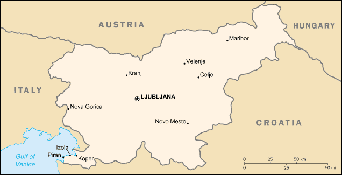
- Capital
- Ljubljana
- Phone Code
- +386
- Voltage
- 230V / 50Hz
- Power Plug
- C, F
- Phone Jack
- RJ-11
- Currency
- Euro
- Dial-up
- $0.155/min
- WiFi
- $19.95/day
About connectivity in Slovenia
Slovenia uses 230V/50Hz with Type C and Type F outlets. The phone jack is RJ-11. Telekom Slovenije, the post-1995 successor to the Slovenian portion of the former Yugoslav PTT, was partially privatized progressively from 1998 onward. A1 Slovenija (formerly Si.mobil, now Telekom Austria-owned), Telemach Slovenia, and T-2 compete in mobile and broadband.
Slovenia's academic ARNES (Akademska in raziskovalna mreža Slovenije) opened the country's first international Internet connection in 1991-1992 over an initial 64 kbps link to CERN — making Slovenia one of the earliest post-Yugoslav-region Internet nodes, with the country's relatively peaceful independence transition (the Ten-Day War was the shortest of the Yugoslav wars) allowing infrastructure investment to continue. Commercial dial-up emerged through the mid-1990s with Telekom Slovenije's Mobitel ISP, K2.net, Volja.net, Avtenta.si, and several regional ISPs. ADSL rollout from Telekom Slovenije began in 2001-2002 and broadband adoption accelerated rapidly. Slovenia consistently ranks in the European top tier for broadband penetration and digital-skills metrics; the country's small population (~2 million), high purchasing power, and EU-funded infrastructure investment have driven faster modernization than most post-Yugoslav peers.
Telekom Slovenije / Mobitel introduced cardphone units in the mid-1990s with chip-card cardphones becoming standard. Mobitel was historically also Slovenia's pioneering mobile operator, launching analog mobile service in 1991 (one of the earliest in the post-Yugoslav region) and GSM in 1996. The Slovenian commemorative phonecard collector market developed substantially through the cardphone era. The prepaid international calling-card market through the 1990s and 2000s served the smaller Slovenian outbound diaspora (Argentina, Australia, the US, Germany, Austria) and the substantial inbound migrant communities from the rest of the former Yugoslavia (Bosnia-Herzegovina, Serbia, Croatia, North Macedonia, Kosovo) calling family back home. Telekom Slovenije payphone fleets have been almost entirely decommissioned through the 2010s.
Tempest Telecom served Slovenia through dial-up POPs in Ljubljana and Maribor, with WiFi at $19.95/day at Brnik Airport and major hotel chains in Ljubljana and Bled. The Julian Alps and Karavanke ranges plus the short Adriatic coastline supported a meaningful Iridium satphone customer base across mountain rescue, expedition, and maritime operations.
Modern Slovenia has dense FTTH coverage in Ljubljana, Maribor, Celje, and Kranj with mature 5G from Telekom Slovenije, A1, and Telemach.
Tempest's services across Slovenia, 1997–2012
Tempest Telecommunications operated international connectivity services in Slovenia between 1997 and 2012 under a unified prepaid account that absorbed multiple service types onto a single customer credential. Customers in Slovenia drew from the same balance for pre-paid international voice calling, RADIUS-authenticated dial-up Internet roaming, metered Wi-Fi hotspot access, Iridium satellite voice, and Inmarsat BGAN data terminals. The PATN kiosk-card clearinghouse (Tempest's TITAN kiOSK, incorporated 2000) extended the same card-and-PIN model to public Internet terminals but did not reach scale.
Iridium satellite voice was available in Slovenia from approximately 2001 (post-bankruptcy relaunch). Thuraya coverage did not extend to Slovenia; Inmarsat BGAN data terminals filled the broadband gap from late 2005.
Nearby countries in Europe
Romania · Russia · Serbia and Montenegro · Slovakia · Spain · Sweden · Switzerland · Ukraine