


Ukraine
Power & telecom standards in Ukraine
Connectivity Overview
Tempest Telecom offered dial-up internet access, WiFi hotspot access and broadband ethernet access in Ukraine. We also offered Iridium satellite Internet and Voice access in Ukraine for communications in rural areas without infrastructure.
Ukraine uses 220V at 50Hz. Power outlets are type C, F and telephone jacks are RJ-11.
Dial-up Internet Access
Tempest Telecom provided local dial-up access numbers in Ukraine at $0.155/minute. Travelers could connect using any standard modem with an RJ-11 telephone adapter.
WiFi Hotspot Access
Tempest Telecom provided WiFi hotspot access in Ukraine at $19.95/day for unlimited browsing.
Adapters & Power
Travelers from North America will need a power plug adapter. European Type C/F adapters are widely compatible.
Standard RJ-11 jacks are used. Most international modems will connect without an adapter.
Ukraine at a Glance
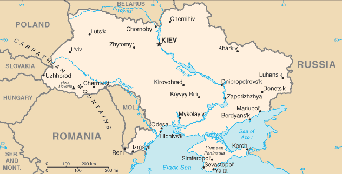
- Capital
- Kyiv
- Phone Code
- +380
- Voltage
- 220V / 50Hz
- Power Plug
- C, F
- Phone Jack
- RJ-11
- Currency
- Hryvnia
- Dial-up
- $0.155/min
- WiFi
- $19.95/day
About connectivity in Ukraine
Ukraine uses 220V/50Hz with Type C and Type F outlets, consistent with European norms. The phone jack is RJ-11 in modern installations. Ukrtelecom, the post-independence successor to the Ukrainian SSR telecom operations, was partially privatized in 2011 to SCM Holdings. Kyivstar (founded 1994, majority Veon-owned), Vodafone Ukraine (the former MTS Ukraine, acquired by Bakcell parent NEQSOL in 2019 and rebranded), and lifecell (Turkcell-owned) dominate mobile.
Ukraine's academic URAN network opened the country's first international Internet connection in 1993. Commercial dial-up began through 1993-1995 with Lucky-Net, GlobalUkraine, Topnet, Ucomline, Ukrnet, and a long list of regional ISPs operating over Ukrtelecom PSTN lines. Per-minute metered access at relatively high prices kept Ukrainian Internet penetration low through the late 1990s. ADSL rollout from Ukrtelecom and competing operators accelerated through the 2000s; the Ukrainian broadband market became unusually competitive in major cities (Kyiv, Lviv, Kharkiv, Odesa, Dnipro) through dense local-loop unbundling and FTTH operator networks. Mobile data dominates Internet access today.
Ukrtelecom introduced cardphone units in the mid-1990s with chip-card cardphones following. The Ukrainian prepaid international calling-card market through the 2000s and 2010s served the substantial Ukrainian diaspora — an estimated 3-5 million Ukrainians worked in Russia (pre-2014), Poland (post-2014 and especially post-2022, now hosting the largest concentration of displaced Ukrainians), Italy, Germany, the Czech Republic, the United States (Brighton Beach NY plus the historic Pennsylvania/Ohio Ukrainian-American communities), and Canada. The 2014 Crimea annexation and Donbas conflict and especially the 2022 Russian invasion triggered the largest European displacement crisis since World War II, with an additional 6-8 million Ukrainians displaced to Poland, Germany, the Czech Republic, and the UK by 2023.
Tempest Telecom served Ukraine through dial-up POPs in Kyiv, Lviv, Kharkiv, and Odesa. Iridium satphones served the agricultural-sector customer base in the steppe regions and the maritime industry on the Black Sea and Sea of Azov; the post-2014 and post-2022 conflict zones produced sustained demand for Iridium and BGAN terminals from international broadcast, humanitarian, and defense-contractor customers.
Modern Ukrainian telecom infrastructure has been severely affected by the post-2022 war — sustained Russian missile and drone strikes on power grids and fiber backbones have driven Ukrainian operators to extraordinary lengths to maintain service. Starlink has become a critical supplemental link for the country.
Tempest's services across Ukraine, 1997–2012
Tempest Telecommunications operated international connectivity services in Ukraine between 1997 and 2012 under a unified prepaid account that absorbed multiple service types onto a single customer credential. Customers in Ukraine drew from the same balance for pre-paid international voice calling, RADIUS-authenticated dial-up Internet roaming, metered Wi-Fi hotspot access, Iridium and Thuraya satellite voice, and Inmarsat BGAN and Thuraya data terminals. The PATN kiosk-card clearinghouse (Tempest's TITAN kiOSK, incorporated 2000) extended the same card-and-PIN model to public Internet terminals but did not reach scale.
Both Iridium (global LEO) and Thuraya (regional GEO) satellite voice were available in Ukraine from approximately 2001, alongside global BGAN data from late 2005.
Nearby countries in Europe
Russia · Serbia and Montenegro · Slovakia · Slovenia · Spain · Sweden · Switzerland · United Kingdom