


Chile
Power & telecom standards in Chile
Connectivity Overview
Tempest Telecom offered dial-up internet access, WiFi hotspot access and broadband ethernet access in Chile. We also offered Iridium satellite Internet and Voice access in Chile for communications in rural areas without infrastructure.
Chile uses 220V at 50Hz. Power outlets are type C, L and telephone jacks are RJ-11.
Dial-up Internet Access
Tempest Telecom provided local dial-up access numbers in Chile at $0.155/minute. Travelers could connect using any standard modem with an RJ-11 telephone adapter.
WiFi Hotspot Access
Tempest Telecom provided WiFi hotspot access in Chile at $19.95/day for unlimited browsing.
Adapters & Power
Travelers from North America will need a power plug adapter. European Type C/F adapters are widely compatible.
Standard RJ-11 jacks are used. Most international modems will connect without an adapter.
Chile at a Glance
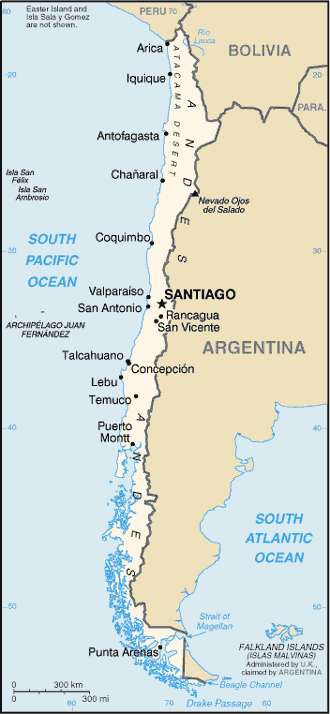
- Capital
- Santiago
- Phone Code
- +56
- Voltage
- 220V / 50Hz
- Power Plug
- C, L
- Phone Jack
- RJ-11
- Currency
- Peso
- Dial-up
- $0.155/min
- WiFi
- $19.95/day
About connectivity in Chile
Chile uses 220V/50Hz with Type C and Type L outlets — the Italian Type L outlet was historically common in Chilean installations. The phone jack is RJ-11. CTC (Compañía de Telecomunicaciones de Chile) was privatized in 1987-1990 in one of Latin America's earliest national-telecom privatizations, eventually becoming Telefónica Chile / Movistar Chile after Telefónica de España's acquisition. ENTEL Chile (originally the state long-distance operator), Claro (América Móvil), and WOM (the rebranded former VTR cable broadband operator) compete in mobile and broadband.
Chile's academic REUNA opened the country's first international Internet connection in 1991. Commercial dial-up emerged through 1993-1995 with CTC's service, Manquehue Net, ENTEL Internet, IFX Networks, and VTR's consumer ISP. Per-minute metered access through CTC PSTN dominated the late 1990s. ADSL rollout from Telefónica Chile's Speedy service began in 2000-2001, with cable broadband from VTR competing aggressively across the 2000s. Chile has consistently been among Latin America's most advanced broadband markets, driven by the country's relatively high purchasing power and concentrated urbanization along the central-coastal corridor.
CTC and ENTEL introduced cardphone units in the early 1990s with chip-card technology becoming standard from the mid-1990s. The Chilean prepaid international calling-card market through the 1990s and 2000s served the post-1973 outbound Chilean diaspora — Chilean-American (concentrated in the Bay Area and Los Angeles), Chilean-Canadian (Toronto and Montreal), Chilean-Australian, Chilean-Swedish (substantial post-1973 refugee community in Stockholm and Göteborg), and Chilean-Argentine populations — plus the growing inbound migration from Peru, Bolivia, and Colombia through the 2010s. Cardphone fleets across Chilean cities have been progressively decommissioned through the 2010s.
Tempest Telecom served Chile through dial-up POPs in Santiago, Valparaíso, Concepción, and Antofagasta. Iridium satphones served the Andean and Patagonian operations — energy-sector customers in the copper-mining belts of Antofagasta and Atacama, agricultural operators in the central valley, expedition crews in Patagonia and Tierra del Fuego, and maritime customers along the long Chilean Pacific coast.
Modern Chile has aggressive FTTH coverage in Santiago and the regional capitals, with mature 4G LTE / 5G nationally. The country is consistently ranked among Latin America's top broadband markets.
Tempest's services across Chile, 1997–2012
Tempest Telecommunications operated international connectivity services in Chile between 1997 and 2012 under a unified prepaid account that absorbed multiple service types onto a single customer credential. Customers in Chile drew from the same balance for pre-paid international voice calling, RADIUS-authenticated dial-up Internet roaming, metered Wi-Fi hotspot access, Iridium satellite voice, and Inmarsat BGAN data terminals. The PATN kiosk-card clearinghouse (Tempest's TITAN kiOSK, incorporated 2000) extended the same card-and-PIN model to public Internet terminals but did not reach scale.
Iridium satellite voice was available in Chile from approximately 2001 (post-bankruptcy relaunch). Thuraya coverage did not extend to Chile; Inmarsat BGAN data terminals filled the broadband gap from late 2005.
Nearby countries in Americas
Bolivia · Brazil · Canada · Cayman Islands · Colombia · Costa Rica · Cuba · Dominica