


Cuba
Power & telecom standards in Cuba
Connectivity Overview
Tempest Telecom offered satellite-only service in Cuba. Iridium satellite Internet and Voice access was available for communications in rural areas without infrastructure.
Cuba uses 110/220V at 60Hz. Power outlets are type A, B, C, L and telephone jacks are RJ-11.
Dial-up Internet Access
Dial-up access was not available in Cuba. Satellite Internet was the recommended alternative.
WiFi Hotspot Access
WiFi hotspot access was not available through Tempest in Cuba.
Adapters & Power
North American (Type A/B) plugs are compatible. An adapter may not be needed for US travelers.
Standard RJ-11 jacks are used. Most international modems will connect without an adapter.
Cuba at a Glance
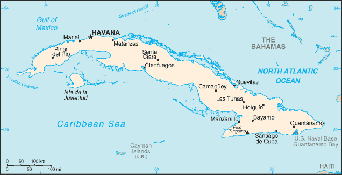
- Capital
- Havana
- Phone Code
- +53
- Voltage
- 110/220V / 60Hz
- Power Plug
- A, B, C, L
- Phone Jack
- RJ-11
- Currency
- Peso
- Dial-up
- N/A
- WiFi
- N/A
About connectivity in Cuba
Cuba uses 110V or 220V depending on installation at 60Hz — nominally dual-voltage with the older infrastructure carrying 110V and newer high-rise residential and tourism installations carrying 220V. Outlets are Type A, Type B, Type C, and Type L — an unusual four-type mix reflecting layered pre-1959 American, post-1959 Soviet/European, and post-1990s tourism-zone installations. The phone jack is RJ-11. ETECSA (Empresa de Telecomunicaciones de Cuba), the state monopoly formed in 1994, has held an exclusive position in Cuban telecom for three decades.
Cuba's commercial Internet history is among the most constrained anywhere — the country's general public did not have legal residential Internet access until 2017. The academic-research CENIAI network had limited international connectivity from 1996; through the 2000s and early 2010s, ETECSA operated tightly-controlled hotel-based Internet access for foreigners and limited government/educational connectivity for Cubans. Public WiFi hotspots began rolling out in 2015 (parques con WiFi), residential ADSL home access launched in late 2017 for limited geographies, and 3G mobile data became publicly available in December 2018. 4G LTE arrived in 2020 and has driven most of the country's recent Internet-access growth. International sanctions and the US embargo have constrained Cuban telecom infrastructure investment throughout this period.
ETECSA introduced cardphone units in the 1990s with chip-card cardphones standard across the country's payphone fleet. ETECSA's prepaid Internet-access cards (the iconic Nauta cards purchased by the hour) became a defining feature of the post-2015 public-WiFi era, with Cubans queuing at ETECSA shops to buy prepaid hourly Internet access. The prepaid international calling-card market through the 1990s, 2000s, and 2010s served the very large Cuban-American diaspora — an estimated 2+ million people of Cuban origin live in the United States, concentrated overwhelmingly in South Florida (Miami-Dade County), New Jersey, and the New York Metropolitan Area. Card brands targeting Cuba destinations sold through Latin American grocery and convenience-store networks in the receiving countries; per-minute rates were historically among the highest in the Western Hemisphere due to the monopoly structure.
Tempest Telecom served Cuba selectively through arrangements compatible with US embargo provisions (general licenses for journalism, NGOs, certain humanitarian categories). Iridium satphones served foreign correspondents, NGO operators, and the cruise and maritime industry serving the Caribbean shipping lanes around Cuban waters. Tempest service inside Cuba was constrained throughout the operational period by sanctions compliance.
Modern Cuba has 4G LTE coverage in major cities (Havana, Santiago de Cuba, Camagüey, Holguín) with limited FTTH deployment. ETECSA's monopoly position and the US embargo continue to shape the operating environment for Cuban telecom investment.
Tempest's services across Cuba, 1997–2012
Tempest Telecommunications operated international connectivity services in Cuba between 1997 and 2012 under a unified prepaid account that absorbed multiple service types onto a single customer credential. Customers in Cuba drew from the same balance for pre-paid international voice calling, RADIUS-authenticated dial-up Internet roaming, metered Wi-Fi hotspot access, Iridium satellite voice, and Inmarsat BGAN data terminals. The PATN kiosk-card clearinghouse (Tempest's TITAN kiOSK, incorporated 2000) extended the same card-and-PIN model to public Internet terminals but did not reach scale.
Iridium satellite voice was available in Cuba from approximately 2001 (post-bankruptcy relaunch). Thuraya coverage did not extend to Cuba; Inmarsat BGAN data terminals filled the broadband gap from late 2005.
Nearby countries in Americas
Cayman Islands · Chile · Colombia · Costa Rica · Dominica · Dominican Republic · Ecuador · El Salvador