


Ecuador
Power & telecom standards in Ecuador
Connectivity Overview
Tempest Telecom offered dial-up internet access, WiFi hotspot access and broadband ethernet access in Ecuador. We also offered Iridium satellite Internet and Voice access in Ecuador for communications in rural areas without infrastructure.
Ecuador uses 120V at 60Hz. Power outlets are type A, B and telephone jacks are RJ-11.
Dial-up Internet Access
Tempest Telecom provided local dial-up access numbers in Ecuador at $0.155/minute. Travelers could connect using any standard modem with an RJ-11 telephone adapter.
WiFi Hotspot Access
Tempest Telecom provided WiFi hotspot access in Ecuador at $19.95/day for unlimited browsing.
Adapters & Power
North American (Type A/B) plugs are compatible. An adapter may not be needed for US travelers.
Standard RJ-11 jacks are used. Most international modems will connect without an adapter.
Ecuador at a Glance
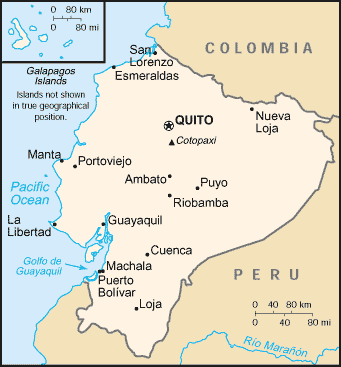
- Capital
- Quito
- Phone Code
- +593
- Voltage
- 120V / 60Hz
- Power Plug
- A, B
- Phone Jack
- RJ-11
- Currency
- USD
- Dial-up
- $0.155/min
- WiFi
- $19.95/day
About connectivity in Ecuador
Ecuador uses 120V/60Hz with Type A and Type B outlets — the North American standard. The phone jack is RJ-11. CNT EP (Corporación Nacional de Telecomunicaciones), the post-2008 merged state operator from the regional Andinatel and Pacifictel companies, holds substantial fixed-line market position. Claro Ecuador (América Móvil), Movistar Ecuador (Telefónica), and CNT Mobile compete in mobile and broadband.
Ecuadorian commercial Internet emerged in the mid-1990s through Pacifictel, Andinatel, and several regional ISPs operating over the regional PSTN networks. Per-minute metered dial-up dominated the late 1990s. ADSL and cable broadband rolled out through the 2000s. The 2000 dollarization (Ecuador adopted the US dollar as its currency following severe currency crisis) reshaped consumer telecom affordability. Mobile data dominates current Internet access.
CNT and predecessor operators introduced cardphone units in the 1990s with chip-card cardphones becoming standard. The Ecuadorian prepaid international calling-card market through the late 1990s and 2000s served the very large Ecuadorian outbound diaspora — the 1999 banking crisis and 2000 dollarization triggered one of the largest emigration waves in modern Ecuadorian history, with concentrated communities in Spain (particularly Madrid and Barcelona; Ecuadorians became one of the largest Latin American communities in Spain), the United States (New York Metropolitan Area, particularly Queens; northern New Jersey), Italy (Milan, Genoa), and the Netherlands. Card brands targeting Ecuadorian destinations sold through Latin American grocery and convenience-store networks.
Tempest Telecom served Ecuador through dial-up POPs in Quito and Guayaquil. Iridium satphones served the Amazonian operations (the Oriente petroleum-extraction region and the broader rainforest expedition customer base), the Galápagos Islands tourism and research operators, the Andean expedition customer base around Cotopaxi and the Avenue of the Volcanoes, and the Pacific coast maritime industry (Guayaquil is South America's largest banana-export port).
Modern Ecuador has expanding 4G LTE coverage with FTTH concentrated in Quito, Guayaquil, and Cuenca. 5G rollout began in 2023.
Tempest's services across Ecuador, 1997–2012
Tempest Telecommunications operated international connectivity services in Ecuador between 1997 and 2012 under a unified prepaid account that absorbed multiple service types onto a single customer credential. Customers in Ecuador drew from the same balance for pre-paid international voice calling, RADIUS-authenticated dial-up Internet roaming, metered Wi-Fi hotspot access, Iridium satellite voice, and Inmarsat BGAN data terminals. The PATN kiosk-card clearinghouse (Tempest's TITAN kiOSK, incorporated 2000) extended the same card-and-PIN model to public Internet terminals but did not reach scale.
Iridium satellite voice was available in Ecuador from approximately 2001 (post-bankruptcy relaunch). Thuraya coverage did not extend to Ecuador; Inmarsat BGAN data terminals filled the broadband gap from late 2005.
Nearby countries in Americas
Costa Rica · Cuba · Dominica · Dominican Republic · El Salvador · French Guiana · Greenland · Grenada