

Aid and Humanitarian Operations: the crisis-zone customer base
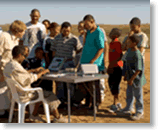
The humanitarian and aid-organization customer base was one of the most consistent long-term customer categories for Tempest Telecommunications. UN agencies (OCHA, UNHCR, WFP, UNICEF, WHO), the International Committee of the Red Cross and the broader Red Cross / Red Crescent network, Médecins Sans Frontières (MSF) and the broader medical-humanitarian sector, dozens of bilateral development agencies (USAID, DFID/FCDO, GIZ, JICA, AusAID), and a long tail of mid-size and small humanitarian NGOs all standardized on satellite- broadband and satellite-voice products through the 2000s and 2010s.
This page documents the broader humanitarian-connectivity context of the era and the specific way Tempest's unified roaming product served the customer base.
Before the 2002 RBGAN launch and the 2005 BGAN successor, humanitarian operations in crisis zones relied on a limited connectivity toolkit:
- HF (shortwave) radio: The long-standing standard for remote- field humanitarian operations dating to the 1970s and earlier. ICRC and MSF both ran substantial HF networks across major operating regions; the technology was reliable in the right propagation conditions but the data-rate ceiling was effectively text-only at HF speeds.
- Inmarsat-A and Inmarsat-B briefcase terminals: Pre-portable satellite voice and slow data, capable of telex-style communications and limited file transfer. Substantial setup time, heavy equipment, high airtime costs.
- Iridium voice (from 1999): True global voice coverage that transformed the personnel-safety side of humanitarian deployment. Iridium became the standard issue handset for field-deployed personnel almost immediately after the 2001 post-bankruptcy second-life pricing made it practical.
Across this period, humanitarian field offices kept paper-based records, ran weekly situation reports to home offices, and operated with substantial communications lag compared to commercial sector workflows of the same era. The category-defining improvement came when portable satellite-broadband terminals (RBGAN from 2002, BGAN from 2005) made meaningful Internet connectivity available to humanitarian field operations for the first time.
Tempest's humanitarian customer base supported major crisis-response operations across the operational era:
- 2004 Indian Ocean tsunami: The December 2004 Sumatra-Andaman earthquake and subsequent tsunami killed an estimated 230,000+ people across Indonesia, Sri Lanka, India, Thailand, and the broader Indian Ocean littoral. RBGAN terminals (just into their third year of commercial deployment) were among the first connectivity tools on the ground with relief teams. The response demonstrated portable-satellite-broadband's practical humanitarian value at a scale that drove subsequent standardization across the sector.
- 2005 Pakistan / Kashmir earthquake: The October 2005 earthquake in the Pakistan-administered Kashmir region killed approximately 87,000 people. BGAN terminals (newly launched that year) supported the international relief response across mountain terrain inaccessible to traditional communications infrastructure.
- 2010 Haiti earthquake: The January 2010 magnitude-7.0 earthquake in Haiti destroyed substantial terrestrial telecom infrastructure and triggered one of the largest humanitarian operations of recent decades. Tempest BGAN deployments supported MSF, the Red Cross, UN agencies, and dozens of mid-size NGOs through the initial-response phase and the long reconstruction period.
- African humanitarian operations: Sustained customer base supporting operations across the Darfur region of Sudan, the Great Lakes region (DRC, Rwanda, Burundi, Uganda), the Horn of Africa (Somalia, Ethiopia, Eritrea), the Sahel (Mali, Niger, Chad), and successive Ebola response operations in West Africa (2014-2016) and the DRC (multiple outbreaks).
- Refugee operations: Standing UNHCR field offices across the major refugee-hosting countries (Jordan, Lebanon, Turkey for the post-2011 Syrian refugee response; Kenya, Ethiopia for the Horn-of-Africa refugee response; Pakistan and Iran for the Afghan refugee population).
- Conflict-zone deployments: Humanitarian operations across Afghanistan, Iraq, Syria, Yemen, and the broader Middle Eastern conflict zones through the 2003-onward US-led operations and successor crises.
Humanitarian customers used Tempest's product set in characteristic patterns:
- Iridium handsets as personnel-safety standard: Field-deployed personnel carried Iridium 9505/9505A units as the personnel-safety baseline, regardless of whether the operating region had terrestrial mobile coverage. The personnel-safety mandate at the major aid organizations made Iridium effectively non-negotiable for international staff in remote-area deployment.
- BGAN terminals at field offices: Permanent and semi-permanent humanitarian field offices in crisis zones deployed BGAN as the primary Internet link, supplementing local terrestrial infrastructure where available and substituting for it where not.
- Pooled-account billing: Major aid organizations with hundreds or thousands of field personnel used Tempest's corporate Account Manager portal to provision and de-provision user accounts as personnel rotated through assignments. The unified-account billing structure allowed central coordination of connectivity spend across decentralized field operations.
- Rental for short-term emergency response: Short-duration disaster-response deployments often rented BGAN equipment rather than buying, with rapid-shipment pre-configured units sent to staging locations as soon as a major event happened. Tempest's rental logistics supported this workflow for the major-event response cycle.
Unlike the corporate-and-individual segments of the unified-roaming category, humanitarian connectivity has not been displaced by mobile-data normalization — crisis-zone connectivity needs are exactly the situations where mobile carriers don't operate. The humanitarian satellite-broadband market has continued through the 2010s and 2020s with progressively improving Inmarsat BGAN equipment, the I-5 Global Xpress Ka-band addition from 2015, the Iridium Certus successor platform from 2018-2019, and most recently the SpaceX Starlink portable terminal product. Major aid organizations have begun adopting Starlink terminals in selected operating regions through 2022-2024 as a per-megabit cost improvement; the legacy Inmarsat and Iridium platforms continue to operate as the redundant or geographically-specific alternatives.
The connectivity-model Tempest helped establish through the operational era — portable broadband + satellite voice + unified-account-management for decentralized field operations — remains the working model for major aid organizations today, even as the carrier-infrastructure layer has shifted to newer constellations.