

Construction and Engineering: the major-project customer base
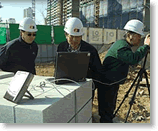
The construction-and-engineering sector was a steady customer category for Tempest Telecommunications across the 2000-2012 operational era. Major-project contractors building dams, highways, ports, pipelines, airports, and large commercial structures in locations that hadn't yet received reliable telecom infrastructure; heavy-engineering teams operating beyond terrestrial-network coverage; disaster-reconstruction logistics teams; and the broader civil-engineering consultancy customer base traveling internationally for project work.
This page documents the broader construction-sector connectivity context of the era and the specific way Tempest's unified roaming product served the customer base.
Construction projects share a distinctive connectivity-need profile with the resource sector: the work happens specifically in places where permanent telecom infrastructure either doesn't exist yet or doesn't cover the project footprint. A highway-construction camp on a new expressway alignment across terrain that had no roads before the project. A hydroelectric-dam construction camp in a river valley far from any urban center. A pipeline-construction crew rolling across a 1,500-km right-of-way through multiple countries. A port-expansion project in a coastal location with limited urban-grade backhaul.
Construction differs from the resource sector in one important way: the connectivity need is bounded in duration. A construction project that runs three years requires three years of connectivity, after which the project demobilizes and the connectivity is no longer needed. A resource-sector extraction site might operate for thirty years and justify permanent VSAT or fiber installation. Construction projects typically don't justify permanent infrastructure investment, which makes portable satellite-broadband the natural fit for the category.
Tempest's construction-customer base spanned project types:
- Major infrastructure construction: Highway, dam, port, airport, and railway construction projects across developing-economy markets. The major international engineering-procurement-construction (EPC) contractors (Bechtel, Fluor, KBR, Saipem, McConnell Dowell, Skanska, Hochtief, Vinci, Bouygues, Larsen & Toubro) all used satellite connectivity at remote project sites through the operational era.
- Pipeline construction: Major oil-and-gas pipeline projects (BTC pipeline Baku-Tbilisi-Ceyhan 2003-2005, the Sakhalin pipelines, the various trans-Saharan and East African pipeline projects, the Central Asian gas pipelines, the Keystone pipeline phases, the Trans-Anatolian and Trans-Adriatic pipelines). Linear projects spanning multiple terrain types and crossing international borders required portable connectivity that could move with the construction front.
- Hydroelectric and large-power-project construction: Major dam construction projects across the developing world (Bui Dam Ghana, Bujagali Uganda, Inga 3 DRC, Grand Ethiopian Renaissance Dam Ethiopia, the various Brazilian Amazon projects, the Chinese-financed African and Asian hydro projects).
- Post-disaster reconstruction: Long-duration reconstruction following the major disasters of the era (Haiti post-2010, Indonesia post-2004 tsunami, Pakistan post-2005 earthquake, Christchurch New Zealand post-2010-11 earthquakes, Japan post-2011 Tōhoku event). Reconstruction phases extending over years required sustained connectivity at sites that hadn't yet been served by reconstructed telecom infrastructure.
- Independent civil engineering consultancies: The major engineering-consulting firms (Arup, AECOM, WSP, Jacobs, Mott MacDonald, Atkins now part of SNC-Lavalin/AtkinsRéalis) used the Tempest unified-roaming account for the substantial international travel their consultancy work required.
Distinctive operational patterns characterized the construction customer base:
- Project-lifecycle billing: Construction projects tended toward project-specific connectivity contracts that ran from mobilization through demobilization. Tempest's usage-only pricing and account-management portal supported provisioning and de-provisioning user accounts as project teams scaled up and down through construction phases.
- Rolling site relocations: Linear projects (pipelines, highways, transmission lines) required connectivity that moved with the construction front. Portable BGAN terminals followed the work, which was a substantial advantage over permanently-installed VSAT that would have required relocation at every move.
- Multi-national project crews: EPC contractors typically staff major projects with international rotation crews drawn from project-team home offices. The Tempest unified-roaming-account billing structure rolled up connectivity spend for crew members across their international itineraries, simplifying the project-team expense management.
- Engineering documentation transfer: Construction projects generate substantial CAD, BIM, survey, and inspection data that has to flow between site teams and home-office engineering staff. BGAN bandwidth was adequate for compressed engineering documents and selective high-resolution transfers (full BIM models and high-resolution survey imagery generally required permanent fiber where available).
Construction-sector connectivity has evolved through the 2010s and 2020s along the same lines as the resource sector. The Inmarsat I-5 Global Xpress Ka-band addition (2015) offered higher throughput for fixed-site project camps that could justify the larger terminal investment. The Iridium Certus successor platform (2018-2019) replaced legacy 9505/9505A handsets for personnel-safety coverage. SpaceX Starlink (2021-onward) substantially undercut Inmarsat BGAN on per-megabit pricing for project sites within Starlink coverage.
The connectivity-pattern Tempest helped establish for the construction sector through the 2002-2012 BGAN era — portable broadband moving with the construction front, project-lifecycle account provisioning, and rolling site re-deployment — survives as the operational model in the post-2020 era even as the underlying carrier infrastructure has shifted to newer constellations.