

Oil, Gas, and Mineral Exploration: the remote-resource-sector customer base
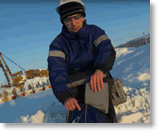
The major hydrocarbon-and-mining sector was one of the most concentrated customer bases for Tempest Telecommunications across the 2000-2012 operational era. Offshore oil-and-gas platforms, remote land-based extraction operations, exploration-stage seismic and survey crews, and the broader mining sector across the Arctic, the Sahara, the Amazon basin, the Central Asian steppe, and the Australian outback deployed Iridium handsets as personnel-safety standard and BGAN terminals as the operations-data link.
This page documents the broader resource-sector connectivity context of the era and the specific way Tempest's product set served the customer base.
Oil, gas, and mineral operations have an unusual connectivity profile compared to most commercial enterprises: the work happens specifically in places where terrestrial telecom infrastructure either doesn't exist or doesn't cover the operational footprint. Offshore platforms in the Gulf of Mexico, the North Sea, offshore West Africa, or the Caspian. Onshore extraction in northern Canada and Russia's Arctic, in the Saudi Empty Quarter, in Kazakhstan's Caspian region, in remote Angola, in offshore Nigerian deepwater. Mineral exploration in the Australian outback (gold, iron ore, lithium), Chilean Atacama (copper, lithium), Mongolian Gobi (copper-gold at Oyu Tolgoi), Indonesian highlands (gold, copper), PNG (Ok Tedi, Porgera). In essentially none of these locations does the local mobile carrier offer reliable coverage.
Two parallel connectivity needs run through the sector:
- Personnel safety: Workers at remote operations need reliable voice contact with operations control, emergency services, and family. The major operators (the supermajors plus the larger national oil companies) adopted personnel-safety standards through the 2000s that effectively mandated satellite-voice handsets for international remote-area deployment, with Iridium the standard product.
- Operations data: SCADA telemetry from remote-site sensors, email and document workflow for site personnel, real-time data linkage with corporate headquarters, ERP and accounting integration, video conferencing for executive-level decision-making about operational issues. BGAN and (post-2015) higher-bandwidth Inmarsat Global Xpress addressed these needs through the portable-broadband category.
Tempest's resource-sector customer base spanned the major operator categories:
- Supermajors: The major international oil companies (BP, Shell, Chevron, ExxonMobil, Total, Eni, ConocoPhillips) all included Iridium handsets in standard issue for field personnel during the operational era. Many deployed Tempest BGAN terminals as the operations-data link at remote sites where project-specific VSAT installations didn't make sense or hadn't yet been deployed.
- National oil companies: The major Middle Eastern NOCs (Saudi Aramco, ADNOC, KOC Kuwait, QatarEnergy, Sonatrach Algeria), the Latin American NOCs (Petrobras, PDVSA, YPF, Pemex), the African NOCs (Sonangol Angola, NNPC Nigeria), and the Asian NOCs (CNPC China, ONGC India, Pertamina Indonesia, Petronas Malaysia) all used Tempest product alongside their primary telecom-infrastructure providers.
- Service contractors: Halliburton, Schlumberger (now SLB), Baker Hughes, Weatherford, Saipem, Subsea 7, McDermott, and the broader service-contractor ecosystem. These customers had highly mobile field crews rotating across multiple operator contracts and operating regions, making Tempest's unified-roaming-account billing structure particularly useful.
- Exploration-stage operators: Seismic-survey crews (CGG-Veritas, WesternGeco, PGS), wildcat exploration teams, geological-survey customers operating in concession areas that hadn't yet received any permanent telecom infrastructure investment.
- Mining sector: The major global miners (BHP, Rio Tinto, Anglo American, Glencore, Newmont, Barrick, Freeport-McMoRan, Vale) and the specialized exploration-stage juniors. Iridium and BGAN deployment at remote extraction sites and exploration camps.
Standard practice at the operator level was redundant communications — the permanent VSAT or microwave-link installation as primary, BGAN as backup, Iridium as personnel-safety. Tempest supplied the BGAN and Iridium tiers of this stack for many customers, often integrated into broader managed-connectivity-service arrangements with the customer's primary telecom provider.
Distinctive deployment patterns characterized the resource-sector customer base:
- Pre-deployment kit-up: Rotation crews going to remote sites arrived with a defined connectivity-kit including (typically) an Iridium handset, an Inmarsat BGAN terminal for the project team, and a Tempest unified-roaming account for inter-leg travel through major-city hubs (Houston, Aberdeen, Dubai, Singapore, Perth) that the rotation passed through.
- Personnel-safety call-in protocols: Daily or weekly check-in schedules between field crews and operations control, with missed check-ins triggering escalation procedures. The Iridium handset was the primary check-in tool; the BGAN terminal supported sustained operations-data workflow between check-ins.
- Sustained-deployment contracts: Multi-year fixed-site operations (offshore platforms, long-duration exploration camps, mining sites in operational production) tended toward owned BGAN equipment with managed airtime; short-duration exploration sweeps tended toward rented equipment with airtime-included rental packages.
The resource sector continued to use BGAN-and-Iridium connectivity through the 2010s and 2020s with progressively improving equipment. The Inmarsat I-5 Global Xpress Ka-band addition (2015) offered higher throughput at the cost of larger terminals and stationary or vehicle-mounted antennas, attractive for fixed-site operations that could justify the infrastructure investment. The Iridium Certus broadband platform (2018-2019) provided a successor to legacy 9505/9505A voice with higher-throughput data on a similar form factor.
Starlink Maritime (2022-onward) and Starlink Roam have substantially undercut Inmarsat BGAN on per-megabit pricing for offshore platforms and remote-site operations through 2023-2024, with major operators piloting Starlink as the primary-operations-data link at selected sites. The legacy Inmarsat and Iridium platforms continue as the redundant or coverage-specific backups, particularly in high-latitude and political-restriction environments where Starlink coverage is unavailable or constrained.