

Broadcast and Media: the foreign-correspondent customer base
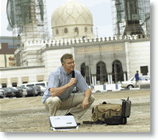
Through the 2003-2012 BGAN-era peak years, broadcast and print journalism was one of the most concentrated customer bases for Tempest Telecommunications' satellite-broadband-terminal product. Foreign correspondents and news-gathering crews from CNN, BBC, Reuters, AP, Al Jazeera, Sky News, ABC, NBC, CBS, the major European and Asian broadcasters, and dozens of mid-tier print and online outlets deployed BGAN terminals and Iridium handsets into the major news-story locations of the era. The combination of unified-roaming-account billing structure with satellite-broadband data made Tempest a meaningful operator in the foreign-correspondent connectivity supply chain.
This page documents the broader broadcast-media-connectivity market of the era and the specific way Tempest's product served the journalism customer base.
Before the 2005 BGAN launch, broadcast journalists working remote locations had limited connectivity options. The category-defining hardware was the satellite-uplink truck: a multi-ton vehicle carrying a 1.8m or 2.4m steerable-dish KU-band uplink to a geostationary satellite, capable of supporting live broadcast-quality video but requiring substantial logistics support to position. The truck-based uplink had been the workflow for international broadcast journalism since the 1980s and persisted as the standard for live feeds through most of the 1990s.
For remote-area print and radio journalism, the alternatives pre-BGAN included Inmarsat-A and Inmarsat-B briefcase terminals (heavy, slow data rates, requiring substantial setup), shortwave-radio voice circuits, and Iridium voice (from 1999 onward) supplemented by very slow data rates over the same satphone. Filing copy from a Sahelian field site involved dictating text over a $7/minute satellite voice call to a receiving editor.
BGAN's 2005 launch redefined the foreign-correspondent connectivity category. A 1-3kg portable terminal that fit in a backpack delivered up to 492 kbps of symmetric data, supported dedicated streaming circuits for live audio and video, and operated globally without ground-segment constraints. A photojournalist in Tahrir Square in 2011 could file high-resolution images directly from the scene; a video crew in a Syrian rebel-held region could send compressed broadcast-quality clips through the same backpack-sized terminal that supported a sat phone call back to the home newsroom.
Tempest's broadcast-media-customer product centered on the BGAN terminal-and-airtime supply chain: Tempest sold and rented BGAN units (the Hughes 9201, 9202, and 9211 plus the Thrane & Thrane Explorer 300, 500, and 700 ranges), provided pre-configured airtime plans optimized for the bursty-data and dedicated-streaming patterns of news gathering, and integrated BGAN usage into the unified Tempest customer account alongside the terrestrial-roaming and satellite-voice products.
The journalism customer use cases through the operational era illustrated the diversity of remote-news-gathering needs:
- Conflict-zone coverage: Foreign correspondents and crews embedded with military operations in Iraq and Afghanistan through the 2003-2014 period; Tahrir Square and the broader Arab Spring coverage of 2011; the early Syrian Civil War coverage from 2011-2014. BGAN was the standard foreign-correspondent data terminal.
- Natural-disaster response: Indian Ocean tsunami 2004 (post-BGAN launch by months), Pakistan earthquake 2005, Haiti earthquake 2010, Japanese Tōhoku earthquake 2011, Nepal earthquake 2015. Major-network response crews routinely deployed BGAN as the first-arrival communications kit.
- Remote-location features: Documentary teams, travel-show productions, science-and-nature programming. National Geographic, BBC Natural History Unit, Discovery Channel productions, the Smithsonian Channel, and the broader specialty-network production category.
- Election coverage and political events: International correspondent deployment for elections in major-story countries, summit coverage, and the rotating major-event journalism calendar (G7/G8 / G20, Olympics, World Cup, major diplomatic events).
Iridium handsets played the conversational-supplement role: a correspondent at a remote site would use the BGAN terminal for filing the story (images, video, text), and an Iridium phone for live phone-in voice conversations with the home newsroom (the BGAN voice option existed but was generally less flexible than a dedicated handset).
The category-defining capability for broadcast journalism was BGAN's dedicated-streaming-circuit option. A correspondent could establish a guaranteed- bandwidth circuit of 56, 128, 176, or 256 kbps for the duration of a live shot, with that bandwidth reserved for the customer's use rather than competing against other BGAN traffic in the shared satellite spot beam. For live broadcast-quality video at era-typical encoding rates, 128-256 kbps was sufficient for compressed MPEG-4 or H.264 video at acceptable broadcast quality — not equal to the full bandwidth of a satellite truck, but sufficient to put a correspondent live-on-air from a field site that could never have hosted a truck-based uplink.
The streaming capability fundamentally changed where broadcast journalism could physically operate. Conflict-zone coverage that previously required either a truck-staging position or store-and-forward editing-back-at-base workflows could now be done live from the field. The combination of compact terminal + global coverage + dedicated streaming bandwidth was the practical capability that defined the 2005-2015 era of foreign correspondent broadcast journalism.
The broadcast-media segment of the satellite-terminal market persisted longer than the unified-roaming corporate category because the underlying remote-location connectivity need has not been displaced by mobile data — conflict zones, natural disasters, and remote-area documentary work still require off-grid connectivity that mobile carriers don't provide. The category continued through the 2010s with progressively improving BGAN equipment, the Inmarsat I-5 / Global Xpress Ka-band addition from 2015 (faster speeds, larger terminals), and the subsequent Iridium Certus broadband platform from 2018-2019.
Newer market entrants since 2020 (SpaceX Starlink with portable Roam terminals, OneWeb commercial, the Eutelsat-OneWeb merger) substantially undercut Inmarsat BGAN on per-megabit pricing while maintaining comparable portability. As of the mid-2020s, much of the broadcast-journalism remote-area connectivity market that Tempest helped pioneer through the 2005-2012 period now runs over Starlink rather than Inmarsat. The connectivity-pattern Tempest helped establish — portable broadband + dedicated streaming + global coverage on a single terminal — survives as the operational model even as the underlying carrier infrastructure has changed hands.