


Uganda
Power & telecom standards in Uganda
Connectivity Overview
Tempest Telecom offered dial-up internet access, WiFi hotspot access and broadband ethernet access in Uganda. We also offered Iridium satellite Internet and Voice access in Uganda for communications in rural areas without infrastructure.
Uganda uses 240V at 50Hz. Power outlets are type G and telephone jacks are RJ-11.
Dial-up Internet Access
Tempest Telecom provided local dial-up access numbers in Uganda at $0.155/minute. Travelers could connect using any standard modem with an RJ-11 telephone adapter.
WiFi Hotspot Access
Tempest Telecom provided WiFi hotspot access in Uganda at $19.95/day for unlimited browsing.
Adapters & Power
A Type G (British 3-pin) adapter is required for travelers from North America, Europe, and most of Asia.
Standard RJ-11 jacks are used. Most international modems will connect without an adapter.
Uganda at a Glance
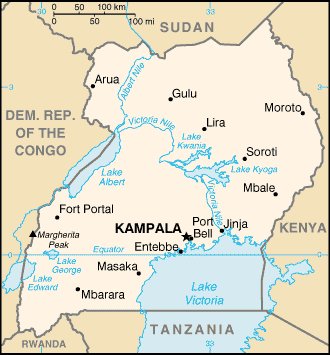
- Capital
- Kampala
- Phone Code
- +256
- Voltage
- 240V / 50Hz
- Power Plug
- G
- Phone Jack
- RJ-11
- Currency
- Shilling
- Dial-up
- $0.155/min
- WiFi
- $19.95/day
About connectivity in Uganda
Uganda uses 240V/50Hz with the British Type G outlet — a legacy of British colonial wiring standards. The phone jack is RJ-11. Uganda Telecom (UTL), the post-1998 successor to the Uganda Posts and Telecommunications Corporation, struggled through the 2010s and entered receivership; the company's assets were eventually transferred to the Uganda Communications Commission. MTN Uganda dominates the mobile market with Airtel Uganda, Africell Uganda (until 2024 exit), and Lyca Mobile Uganda competing.
Uganda's commercial Internet history traces to 1995-1996 with Starcom, Infocom, and a handful of regional ISPs operating over Uganda Telecom's PSTN infrastructure. Per-minute metered dial-up at relatively high prices kept Ugandan Internet penetration low through the late 1990s and early 2000s. The transformative development was the 2009 arrival of the SEACOM underwater fiber-optic cable (Uganda receives international bandwidth via terrestrial onward-connection from Kenyan landing stations at Mombasa), which dramatically expanded backbone capacity. Mobile data dominates current Ugandan Internet access; MTN Mobile Money and Airtel Money provide widely-used mobile-money services across the country, paralleling Kenya's M-Pesa pattern.
Uganda Telecom's cardphone deployment was limited — mobile prepaid airtime quickly became the dominant prepaid product. The Ugandan prepaid international calling-card market through the 2000s and 2010s served the substantial Ugandan diaspora — concentrated in the United Kingdom (one of the larger African diaspora communities in Britain, with deep roots dating to the Idi Amin-era 1972 expulsion of South Asians from Uganda and the broader post-independence professional migration), the United States, Canada, South Africa, and the broader East African Community labor circuit.
Tempest Telecom served Uganda through dial-up POPs in Kampala. Iridium satphones served the substantial NGO and humanitarian customer base (the country has been a major refugee-hosting nation throughout the 2000s-2020s, with operations supporting South Sudanese, Congolese, Rwandan, and Burundian refugee populations), expedition crews supporting the Rwenzori Mountains and Murchison Falls operations, gorilla-tourism operators in Bwindi Impenetrable Forest, and corporate logistics across the regional East African Community customer base.
Modern Uganda has expanding mobile-data coverage with 4G LTE in major cities; FTTH is concentrated in Kampala. Internet access has been subject to periodic government shutdowns during election periods (notably the January 2021 election shutdown).
Tempest's services across Uganda, 1997–2012
Tempest Telecommunications operated international connectivity services in Uganda between 1997 and 2012 under a unified prepaid account that absorbed multiple service types onto a single customer credential. Customers in Uganda drew from the same balance for pre-paid international voice calling, RADIUS-authenticated dial-up Internet roaming, metered Wi-Fi hotspot access, Iridium and Thuraya satellite voice, and Inmarsat BGAN and Thuraya data terminals. The PATN kiosk-card clearinghouse (Tempest's TITAN kiOSK, incorporated 2000) extended the same card-and-PIN model to public Internet terminals but did not reach scale.
Both Iridium (global LEO) and Thuraya (regional GEO) satellite voice were available in Uganda from approximately 2001, alongside global BGAN data from late 2005.
Nearby countries in Africa
South Africa · Sudan · Swaziland · Tanzania · Togo · Tunisia · Zambia · Zimbabwe