

Zimbabwe
Power & telecom standards in Zimbabwe
Connectivity Overview
Tempest Telecom offered dial-up internet access, WiFi hotspot access and broadband ethernet access in Zimbabwe. We also offered Iridium satellite Internet and Voice access in Zimbabwe for communications in rural areas without infrastructure.
Zimbabwe uses 220V at 50Hz. Power outlets are type D, G and telephone jacks are RJ-11.
Dial-up Internet Access
Tempest Telecom provided local dial-up access numbers in Zimbabwe at $0.255/minute. Travelers could connect using any standard modem with an RJ-11 telephone adapter.
WiFi Hotspot Access
Tempest Telecom provided WiFi hotspot access in Zimbabwe at $19.95/day for unlimited browsing.
Adapters & Power
A Type G (British 3-pin) adapter is required for travelers from North America, Europe, and most of Asia.
Standard RJ-11 jacks are used. Most international modems will connect without an adapter.
Zimbabwe at a Glance
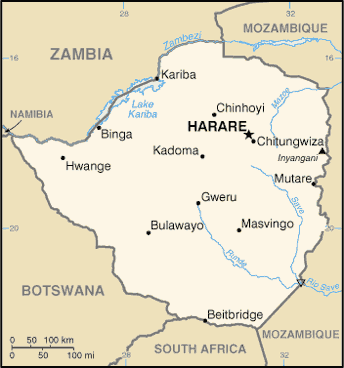
- Capital
- Harare
- Phone Code
- +263
- Voltage
- 220V / 50Hz
- Power Plug
- D, G
- Phone Jack
- RJ-11
- Currency
- ZWL
- Dial-up
- $0.255/min
- WiFi
- $19.95/day
About connectivity in Zimbabwe
Zimbabwe uses 220V/50Hz with Type D and Type G outlets — a legacy of British colonial wiring standards from the Southern Rhodesia era. The phone jack is RJ-11. TelOne, the state fixed-line operator (the post-2000 successor to the PTC), competes with Econet Wireless (Zimbabwe's largest mobile operator, founded by Strive Masiyiwa in 1998 after a multi-year legal battle for licensing), NetOne (state-owned mobile), and Telecel Zimbabwe.
Zimbabwean commercial Internet emerged in 1996-1997 through Mango Net (one of the earliest), Africa Online Zimbabwe, and ZimOnline. Per-minute metered dial-up through PTC/TelOne PSTN dominated the late 1990s and 2000s. The country's hyperinflation crisis of 2007-2009 (peak monthly inflation reached an estimated 79.6 billion percent in November 2008) severely disrupted telecom infrastructure investment and operations. Post-2009 dollarization and subsequent currency reforms have shaped subsequent connectivity development; mobile data dominates current access, with Econet's EcoCash mobile-money platform widely used.
PTC/TelOne cardphone deployment was modest, with mobile prepaid airtime becoming the dominant prepaid product through the 2000s. The Zimbabwean prepaid international calling-card market through the 2000s and 2010s served the very large post-2000 Zimbabwean outbound diaspora — the country's economic collapse from the early 2000s onward drove an estimated 3-5 million Zimbabweans abroad, concentrated overwhelmingly in South Africa (the largest single diaspora destination), the United Kingdom (London, Manchester, Leeds), Botswana, Australia, the United States, and Canada. Card brands targeting Zimbabwean Shona-, Ndebele-, and English-language destinations sold through African-grocery networks in the receiving countries.
Tempest Telecom served Zimbabwe through dial-up POPs in Harare. Iridium satphones served the safari tourism operators across Hwange National Park and Mana Pools, the tobacco-trading sector in the central highlands, the Zambezi River and Victoria Falls expedition customer base, and NGO operators across the post-crisis humanitarian customer base.
Modern Zimbabwe has expanding mobile-data coverage with 4G LTE in major cities; FTTH is concentrated in Harare and Bulawayo. Currency and economic volatility continues to shape consumer telecom affordability and infrastructure investment.
Tempest's services across Zimbabwe, 1997–2012
Tempest Telecommunications operated international connectivity services in Zimbabwe between 1997 and 2012 under a unified prepaid account that absorbed multiple service types onto a single customer credential. Customers in Zimbabwe drew from the same balance for pre-paid international voice calling, RADIUS-authenticated dial-up Internet roaming, metered Wi-Fi hotspot access, Iridium and Thuraya satellite voice, and Inmarsat BGAN and Thuraya data terminals. The PATN kiosk-card clearinghouse (Tempest's TITAN kiOSK, incorporated 2000) extended the same card-and-PIN model to public Internet terminals but did not reach scale.
Both Iridium (global LEO) and Thuraya (regional GEO) satellite voice were available in Zimbabwe from approximately 2001, alongside global BGAN data from late 2005.
Nearby countries in Africa
Algeria · Angola · Benin · Botswana · Burkina Faso · Burundi · Cameroon · Cape Verde