


Algeria
Power & telecom standards in Algeria
Connectivity Overview
Tempest Telecom offered dial-up internet access, WiFi hotspot access and broadband ethernet access in Algeria. We also offered Iridium satellite Internet and Voice access in Algeria for communications in rural areas without infrastructure.
Algeria uses 230V at 50Hz. Power outlets are type C, F and telephone jacks are RJ-11.
Dial-up Internet Access
Tempest Telecom provided local dial-up access numbers in Algeria at $0.155/minute. Travelers could connect using any standard modem with an RJ-11 telephone adapter.
WiFi Hotspot Access
Tempest Telecom provided WiFi hotspot access in Algeria at $19.95/day for unlimited browsing.
Adapters & Power
Travelers from North America will need a power plug adapter. European Type C/F adapters are widely compatible.
Standard RJ-11 jacks are used. Most international modems will connect without an adapter.
Algeria at a Glance
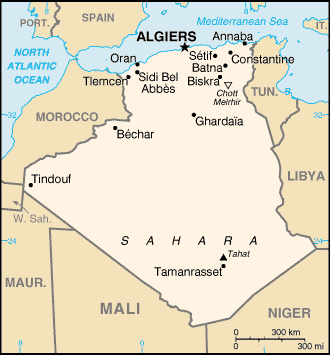
- Capital
- Algiers
- Phone Code
- +213
- Voltage
- 230V / 50Hz
- Power Plug
- C, F
- Phone Jack
- RJ-11
- Currency
- Dinar
- Dial-up
- $0.155/min
- WiFi
- $19.95/day
About connectivity in Algeria
Algeria uses 230V/50Hz with Type C and Type F outlets. The phone jack is RJ-11. Algérie Telecom, the state-owned fixed-line operator, was structurally separated from the postal service in 2000 and remains state-controlled. The mobile market is contested by Mobilis (Algérie Telecom Mobile), Ooredoo Algeria (Qatari Ooredoo-owned), and Djezzy (the Veon-controlled brand). The Algerian Communications Regulatory Authority (ARPT) regulates.
Algeria's academic CERIST opened the country's first international Internet connection in 1993. Commercial dial-up was authorized through state-licensed ISPs from 1998 onward, with EEPAD (Établissement Public à Caractère Économique pour l'Internet et le Multimédia), Algeria Online, and a small number of regional providers operating over Algérie Telecom PSTN at relatively high state-set prices. Internet penetration grew slowly through the 2000s and accelerated through the 2010s as 3G and 4G mobile services expanded. Algerian Internet has been subject to occasional government-imposed shutdowns during periods of political tension and during national exam periods (a notable annual practice from the late 2010s onward).
Algérie Telecom introduced cardphone units in the 1990s with chip-card cardphones becoming standard. The Algerian prepaid international calling-card market through the 1990s, 2000s, and 2010s served the enormous Algerian outbound diaspora — concentrated in France (an estimated 1.5+ million people of Algerian origin, by far the largest immigrant-origin community in France, with deep roots dating to the colonial era and the post-1962 independence migration), Spain, Belgium, Germany, Italy, and the broader Maghreb labor circuit. Card brands targeting Algerian destinations sold through North African-grocery and convenience-store networks across the receiving countries, particularly in Paris, Marseille, Lyon, and the Île-de-France inner-city districts.
Tempest Telecom served Algeria through dial-up POPs in Algiers and Oran. The Sahara desert (the world's largest, with substantial Algerian hydrocarbon-sector operations in Hassi Messaoud and other oil-and-gas fields), the Atlas Mountains, and the Mediterranean maritime industry were a meaningful Iridium satphone market. Tempest service in Algeria was complicated through extended periods by the country's 1990s civil-war security environment.
Modern Algeria has expanding 4G LTE coverage with 5G rollout beginning in 2024; FTTH is concentrated in Algiers and the coastal cities.
Tempest's services across Algeria, 1997–2012
Tempest Telecommunications operated international connectivity services in Algeria between 1997 and 2012 under a unified prepaid account that absorbed multiple service types onto a single customer credential. Customers in Algeria drew from the same balance for pre-paid international voice calling, RADIUS-authenticated dial-up Internet roaming, metered Wi-Fi hotspot access, Iridium and Thuraya satellite voice, and Inmarsat BGAN and Thuraya data terminals. The PATN kiosk-card clearinghouse (Tempest's TITAN kiOSK, incorporated 2000) extended the same card-and-PIN model to public Internet terminals but did not reach scale.
Both Iridium (global LEO) and Thuraya (regional GEO) satellite voice were available in Algeria from approximately 2001, alongside global BGAN data from late 2005.
Nearby countries in Africa
Angola · Benin · Botswana · Burkina Faso · Burundi · Cameroon · Cape Verde · Central African Republic