


Kenya
Power & telecom standards in Kenya
Connectivity Overview
Tempest Telecom offered dial-up internet access, WiFi hotspot access and broadband ethernet access in Kenya. We also offered Iridium satellite Internet and Voice access in Kenya for communications in rural areas without infrastructure.
Kenya uses 240V at 50Hz. Power outlets are type G and telephone jacks are RJ-11.
Dial-up Internet Access
Tempest Telecom provided local dial-up access numbers in Kenya at $0.255/minute. Travelers could connect using any standard modem with an RJ-11 telephone adapter.
WiFi Hotspot Access
Tempest Telecom provided WiFi hotspot access in Kenya at $19.95/day for unlimited browsing.
Adapters & Power
A Type G (British 3-pin) adapter is required for travelers from North America, Europe, and most of Asia.
Standard RJ-11 jacks are used. Most international modems will connect without an adapter.
Kenya at a Glance
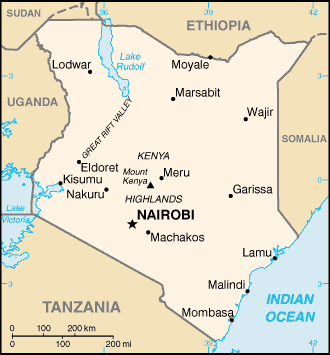
- Capital
- Nairobi
- Phone Code
- +254
- Voltage
- 240V / 50Hz
- Power Plug
- G
- Phone Jack
- RJ-11
- Currency
- Shilling
- Dial-up
- $0.255/min
- WiFi
- $19.95/day
About connectivity in Kenya
Kenya uses 240V/50Hz with the British Type G outlet — a legacy of British colonial wiring standards. The phone jack is RJ-11. Telkom Kenya, founded in 1999 from the Kenya Posts and Telecommunications Corporation, was partially privatized from 2007 with France Télécom (now Orange) taking a stake until exiting in 2016. The mobile market is dominated by Safaricom (founded 2000, majority Vodafone-owned, the operator of the world's most-cited mobile-money platform M-Pesa) with competition from Airtel Kenya and Telkom Kenya.
Kenya's academic KENET network began Internet connectivity from the early 1990s. Commercial dial-up service began in 1995-1996 with Africa Online (one of the earliest pan-African ISPs), Form-Net, NairobiNet, and Wananchi Online. Per-minute metered access through Telkom PSTN at high prices kept Kenyan Internet penetration low through the late 1990s and early 2000s. The transformative development was the 2009 arrival of the SEACOM underwater fiber-optic cable, followed by EASSy and TEAMS — these ended East Africa's historic satellite-dependence for international bandwidth and dropped retail prices substantially. Mobile data has played an outsize role in Kenyan Internet access since the 2010s; the country's mobile-data and mobile-money ecosystem (anchored by Safaricom M-Pesa, launched March 2007) is studied globally as a leapfrog example.
Kenya's public payphone history was substantially shaped by Telkom Kenya's prepaid card system from the 1990s onward. The Kenyan prepaid international calling-card market through the 2000s served the substantial Kenyan diaspora in the US, UK, Canada, Germany, and the Gulf states. Outbound calling cards were sold through dukas (small neighborhood shops) and cybercafes across Nairobi, Mombasa, Kisumu, and Nakuru. The cardphone fleet has been largely retired since the early 2010s as mobile penetration approached saturation and M-Pesa replaced cash and card-based prepaid payments for most low-value transactions.
Tempest Telecom served Kenya through dial-up POPs in Nairobi and Mombasa. Kenya was a strong Iridium satphone customer base for safari tourism operators, the East African shipping/maritime sector via Mombasa port, NGO and humanitarian operators working across the Great Lakes region (including USAID and broader international-aid customers operating from Nairobi as the regional hub), and expedition crews supporting Kilimanjaro and Mount Kenya climbing programs. BGAN data terminals served the same customer mix once Inmarsat's I-4 constellation provided global coverage from late 2005. The country also served as a regional hub for Tempest's coverage of South Sudan, Somalia, and northern Tanzania humanitarian and corporate customers, all settled through the unified prepaid platform.
Modern Kenya has the most sophisticated mobile-money ecosystem in the world via Safaricom's M-Pesa, mature 4G LTE coverage in populated areas, and expanding FTTH in Nairobi and Mombasa.
Tempest's services across Kenya, 1997–2012
Tempest Telecommunications operated international connectivity services in Kenya between 1997 and 2012 under a unified prepaid account that absorbed multiple service types onto a single customer credential. Customers in Kenya drew from the same balance for pre-paid international voice calling, RADIUS-authenticated dial-up Internet roaming, metered Wi-Fi hotspot access, Iridium and Thuraya satellite voice, and Inmarsat BGAN and Thuraya data terminals. The PATN kiosk-card clearinghouse (Tempest's TITAN kiOSK, incorporated 2000) extended the same card-and-PIN model to public Internet terminals but did not reach scale.
Both Iridium (global LEO) and Thuraya (regional GEO) satellite voice were available in Kenya from approximately 2001, alongside global BGAN data from late 2005.
Nearby countries in Africa
Ghana · Guinea · Guinea-Bissau · Ivory Coast · Lesotho · Liberia · Libya · Madagascar