


Ivory Coast
Power & telecom standards in Ivory Coast
Connectivity Overview
Tempest Telecom offered dial-up internet access, WiFi hotspot access and broadband ethernet access in Ivory Coast. We also offered Iridium satellite Internet and Voice access in Ivory Coast for communications in rural areas without infrastructure.
Ivory Coast uses 220V at 50Hz. Power outlets are type C, E and telephone jacks are RJ-11.
Dial-up Internet Access
Tempest Telecom provided local dial-up access numbers in Ivory Coast at $0.255/minute. Travelers could connect using any standard modem with an RJ-11 telephone adapter.
WiFi Hotspot Access
Tempest Telecom provided WiFi hotspot access in Ivory Coast at $19.95/day for unlimited browsing.
Adapters & Power
Travelers from North America will need a power plug adapter. European Type C/F adapters are widely compatible.
Standard RJ-11 jacks are used. Most international modems will connect without an adapter.
Ivory Coast at a Glance
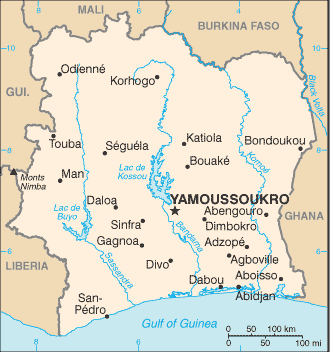
- Capital
- Yamoussoukro
- Phone Code
- +225
- Voltage
- 220V / 50Hz
- Power Plug
- C, E
- Phone Jack
- RJ-11
- Currency
- CFA Franc
- Dial-up
- $0.255/min
- WiFi
- $19.95/day
About connectivity in Ivory Coast
Côte d'Ivoire (Ivory Coast) uses 220V/50Hz with Type C and Type E outlets — the French-standard wiring reflecting the colonial-era infrastructure heritage. The phone jack is RJ-11. Côte d'Ivoire Télécom (CIT, the post-1990 successor to the state telecom operations) was partially privatized to France Télécom in 1996, eventually becoming Orange Côte d'Ivoire. MTN Côte d'Ivoire and Moov Africa Côte d'Ivoire (the post-Maroc Telecom-Etisalat-Atlantique-Telecom regional brand) compete in mobile and broadband.
Côte d'Ivoire's academic and commercial Internet began in 1996 through CIT's consumer service and Aviso (one of the earliest commercial Ivorian ISPs). Per-minute metered dial-up over CIT PSTN dominated the late 1990s. The 2002 arrival of the SAT-3/WASC underwater fiber-optic cable substantially expanded international bandwidth. Côte d'Ivoire's 2002-2007 civil war and the 2010-2011 post-election crisis disrupted telecom infrastructure investment periodically. Mobile data dominates current Internet access; the country has become a notable West African hub for mobile-money and fintech services.
CIT introduced cardphone units in the 1990s with chip-card cardphones standard. The Ivorian prepaid international calling-card market through the 1990s and 2000s served the substantial outbound Ivorian diaspora — concentrated in France (one of the larger Sub-Saharan African communities in France, particularly in the Paris region and Île-de-France), Italy, the United States, and across the West African ECOWAS labor circuit. Côte d'Ivoire's historic position as the largest economy in francophone West Africa also made Abidjan a meaningful inbound migrant-labor destination, with workers from Burkina Faso, Mali, Guinea, and Niger sustaining additional outbound card volume.
Tempest Telecom served Côte d'Ivoire through dial-up POPs in Abidjan. The city's position as a francophone West African business hub and Atlantic-coast port generated sustained business-traveler dial-up roaming and maritime Iridium demand. The cocoa-trading sector (Côte d'Ivoire is the world's largest cocoa producer) drove significant agricultural-logistics customer demand for satellite voice across the rural cocoa belt.
Modern Côte d'Ivoire has expanding mobile-data coverage with 4G LTE in populated areas; FTTH is concentrated in Abidjan. 5G rollout from Orange and MTN began in 2024.
Tempest's services across Ivory Coast, 1997–2012
Tempest Telecommunications operated international connectivity services in Ivory Coast between 1997 and 2012 under a unified prepaid account that absorbed multiple service types onto a single customer credential. Customers in Ivory Coast drew from the same balance for pre-paid international voice calling, RADIUS-authenticated dial-up Internet roaming, metered Wi-Fi hotspot access, Iridium and Thuraya satellite voice, and Inmarsat BGAN and Thuraya data terminals. The PATN kiosk-card clearinghouse (Tempest's TITAN kiOSK, incorporated 2000) extended the same card-and-PIN model to public Internet terminals but did not reach scale.
Both Iridium (global LEO) and Thuraya (regional GEO) satellite voice were available in Ivory Coast from approximately 2001, alongside global BGAN data from late 2005.
Nearby countries in Africa
Gambia · Ghana · Guinea · Guinea-Bissau · Kenya · Lesotho · Liberia · Libya