


Libya
Power & telecom standards in Libya
Connectivity Overview
Tempest Telecom offered satellite-only service in Libya. Iridium satellite Internet and Voice access was available for communications in rural areas without infrastructure.
Libya uses 230V at 50Hz. Power outlets are type C, D, F, L and telephone jacks are RJ-11.
Dial-up Internet Access
Dial-up access was not available in Libya. Satellite Internet was the recommended alternative.
WiFi Hotspot Access
WiFi hotspot access was not available through Tempest in Libya.
Adapters & Power
Travelers from North America will need a power plug adapter. European Type C/F adapters are widely compatible.
Standard RJ-11 jacks are used. Most international modems will connect without an adapter.
Libya at a Glance
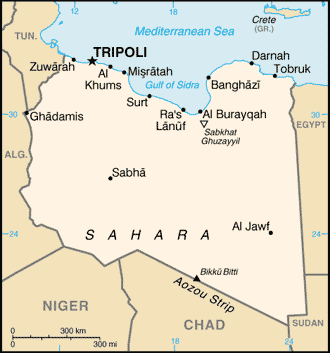
- Capital
- Tripoli
- Phone Code
- +218
- Voltage
- 230V / 50Hz
- Power Plug
- C, D, F, L
- Phone Jack
- RJ-11
- Currency
- Dinar
- Dial-up
- N/A
- WiFi
- N/A
About connectivity in Libya
Libya uses 230V/50Hz with Type C, Type D, Type F, and Type L outlets — an unusual four-type mix reflecting layered Italian colonial-era (Type L from the 1934-1947 occupation), Anglo-American post-WWII influence, and modern European-standard installations. The phone jack is RJ-11. The Libyan telecom sector is operated by the state-controlled General Telecommunications Authority (GPTC) and its subsidiaries Libyana and Al Madar (the country's two mobile networks). The post-2011 civil war and ongoing political fragmentation between competing governments in Tripoli and Tobruk have constrained telecom-infrastructure investment and operator participation.
Libyan commercial Internet emerged in 1998 through GPTC, with state-controlled access through the Gaddafi era. International bandwidth was historically routed through Mediterranean underwater cables. The 2011 NATO-supported overthrow of Gaddafi and subsequent civil-war periods have repeatedly disrupted backbone infrastructure. Mobile data dominates current Internet access.
GPTC cardphone deployment was modest. The Libyan prepaid international calling-card market through the 2000s served the modest Libyan outbound diaspora. The post-2011 civil-war displacement triggered a substantially larger Libyan diaspora and refugee outflow — concentrated in Tunisia, Egypt, Turkey, Italy (a historical-cultural-language destination with the Italian-Libyan colonial diaspora connection), the United Kingdom, and increasingly the broader EU. The pre-2011 substantial inbound Sub-Saharan African migrant labor population, plus the post-2011 transit-migration through Libya toward Europe, sustained additional outbound card volume.
Tempest Telecom served Libya through dial-up POPs in Tripoli. Iridium satphones served the very substantial Libyan oil-and-gas sector (Libya holds Africa's largest proven oil reserves, with operations across the Sirte Basin and the broader Saharan oilfields), archaeological-research operators across the country's major UNESCO heritage sites (Cyrene, Leptis Magna, Sabratha, the Ghadames Old Town), and the post-2011 humanitarian and broadcast-journalist customer base operating across the civil-war zones.
Modern Libya has degraded telecom infrastructure across much of the country due to ongoing political fragmentation. Mobile coverage exists in populated areas but service quality varies by region and the controlling authority.
Tempest's services across Libya, 1997–2012
Tempest Telecommunications operated international connectivity services in Libya between 1997 and 2012 under a unified prepaid account that absorbed multiple service types onto a single customer credential. Customers in Libya drew from the same balance for pre-paid international voice calling, RADIUS-authenticated dial-up Internet roaming, metered Wi-Fi hotspot access, Iridium and Thuraya satellite voice, and Inmarsat BGAN and Thuraya data terminals. The PATN kiosk-card clearinghouse (Tempest's TITAN kiOSK, incorporated 2000) extended the same card-and-PIN model to public Internet terminals but did not reach scale.
Both Iridium (global LEO) and Thuraya (regional GEO) satellite voice were available in Libya from approximately 2001, alongside global BGAN data from late 2005.
Nearby countries in Africa
Ivory Coast · Kenya · Lesotho · Liberia · Madagascar · Malawi · Mali · Mauritania