


Haiti
Power & telecom standards in Haiti
Connectivity Overview
Tempest Telecom offered dial-up internet access, WiFi hotspot access and broadband ethernet access in Haiti. We also offered Iridium satellite Internet and Voice access in Haiti for communications in rural areas without infrastructure.
Haiti uses 110V at 60Hz. Power outlets are type A, B and telephone jacks are RJ-11.
Dial-up Internet Access
Tempest Telecom provided local dial-up access numbers in Haiti at $0.155/minute. Travelers could connect using any standard modem with an RJ-11 telephone adapter.
WiFi Hotspot Access
Tempest Telecom provided WiFi hotspot access in Haiti at $19.95/day for unlimited browsing.
Adapters & Power
North American (Type A/B) plugs are compatible. An adapter may not be needed for US travelers.
Standard RJ-11 jacks are used. Most international modems will connect without an adapter.
Haiti at a Glance
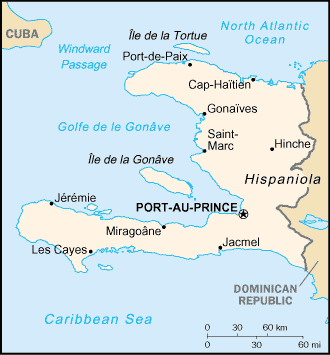
- Capital
- Port-au-Prince
- Phone Code
- +509
- Voltage
- 110V / 60Hz
- Power Plug
- A, B
- Phone Jack
- RJ-11
- Currency
- Gourde
- Dial-up
- $0.155/min
- WiFi
- $19.95/day
About connectivity in Haiti
Haiti uses 110V/60Hz with Type A and Type B outlets — the North American standard, despite the historic French colonial heritage. The phone jack is RJ-11. Téléco (Haiti's state telecom operator) struggled through the 1990s and 2000s; the company was effectively dismantled during the post-2010-earthquake reconstruction. The mobile market is dominated by Digicel Haiti (founded 2006) and Natcom (the post-2010 successor that absorbed parts of Téléco's infrastructure, majority-owned by Vietnamese Viettel).
Haitian commercial Internet emerged in the late 1990s through limited ISP operations, with low penetration through the 2000s due to fixed-line infrastructure limitations. The January 2010 magnitude-7.0 earthquake destroyed substantial portions of the country's telecom backbone, requiring extensive post-disaster reconstruction. Mobile data has driven essentially all of Haiti's recent Internet-access growth; Digicel Haiti operates one of the largest and most profitable mobile networks in the Caribbean despite the country's extreme poverty and infrastructure challenges.
Téléco's cardphone deployment was modest. The Haitian prepaid international calling-card market through the 1990s, 2000s, and 2010s was substantial in proportion to the country's population (~11 million), driven by the very large Haitian diaspora — concentrated in the United States (particularly Brooklyn New York, the broader New York Metropolitan Area, Miami, and Boston), Canada (particularly Montreal, which hosts the largest Haitian community outside Haiti through deep francophone-cultural ties), France, the Dominican Republic (often as undocumented labor), and the broader Caribbean. Haitian Kreyòl-language card brands targeting Port-au-Prince and Cap-Haïtien destinations sold through Haitian-grocery networks in the receiving countries.
Tempest Telecom served Haiti through dial-up POPs in Port-au-Prince before 2010. Post-earthquake, Iridium satphones became central to the international humanitarian response — the January 2010 disaster killed an estimated 100,000+ people and triggered one of the largest humanitarian operations in recent history. Tempest's satellite voice and BGAN data supported broadcast journalists, NGO operators (Médecins Sans Frontières, the Red Cross, dozens of international aid agencies), and the post-disaster reconstruction logistics customer base.
Modern Haiti has expanding 4G LTE coverage in Port-au-Prince and the larger regional centers; political instability and recurring natural disasters continue to constrain infrastructure investment.
Tempest's services across Haiti, 1997–2012
Tempest Telecommunications operated international connectivity services in Haiti between 1997 and 2012 under a unified prepaid account that absorbed multiple service types onto a single customer credential. Customers in Haiti drew from the same balance for pre-paid international voice calling, RADIUS-authenticated dial-up Internet roaming, metered Wi-Fi hotspot access, Iridium satellite voice, and Inmarsat BGAN data terminals. The PATN kiosk-card clearinghouse (Tempest's TITAN kiOSK, incorporated 2000) extended the same card-and-PIN model to public Internet terminals but did not reach scale.
Iridium satellite voice was available in Haiti from approximately 2001 (post-bankruptcy relaunch). Thuraya coverage did not extend to Haiti; Inmarsat BGAN data terminals filled the broadband gap from late 2005.
Nearby countries in Americas
Grenada · Guadeloupe · Guatemala · Guyana · Honduras · Jamaica · Martinique · Mexico