


Guatemala
Power & telecom standards in Guatemala
Connectivity Overview
Tempest Telecom offered dial-up internet access, WiFi hotspot access and broadband ethernet access in Guatemala. We also offered Iridium satellite Internet and Voice access in Guatemala for communications in rural areas without infrastructure.
Guatemala uses 120V at 60Hz. Power outlets are type A, B and telephone jacks are RJ-11.
Dial-up Internet Access
Tempest Telecom provided local dial-up access numbers in Guatemala at $0.155/minute. Travelers could connect using any standard modem with an RJ-11 telephone adapter.
WiFi Hotspot Access
Tempest Telecom provided WiFi hotspot access in Guatemala at $19.95/day for unlimited browsing.
Adapters & Power
North American (Type A/B) plugs are compatible. An adapter may not be needed for US travelers.
Standard RJ-11 jacks are used. Most international modems will connect without an adapter.
Guatemala at a Glance
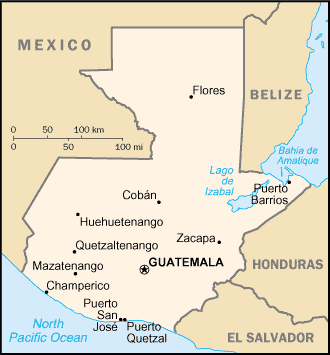
- Capital
- Guatemala City
- Phone Code
- +502
- Voltage
- 120V / 60Hz
- Power Plug
- A, B
- Phone Jack
- RJ-11
- Currency
- Quetzal
- Dial-up
- $0.155/min
- WiFi
- $19.95/day
About connectivity in Guatemala
Guatemala uses 120V/60Hz with Type A and Type B outlets — the North American standard. The phone jack is RJ-11. Telgua (Telecomunicaciones de Guatemala), the post-1998 privatized successor to the state Guatel operations, was acquired by Mexican Telmex (now América Móvil) and operates today as Claro Guatemala. Tigo Guatemala (Millicom) is the country's largest mobile operator, with Movistar Guatemala (Telefónica, exiting the market) and Claro competing.
Guatemalan commercial Internet emerged in 1995-1996 through Telgua's consumer service and several regional ISPs operating over Guatel/Telgua PSTN. Per-minute metered dial-up dominated the late 1990s. ADSL and cable broadband rolled out through the 2000s, with mobile data becoming the dominant access method through 2010s 3G/4G adoption. Tigo's aggressive mobile-money rollout (Tigo Money) has driven substantial financial-inclusion gains across the country's large unbanked rural population.
Telgua introduced cardphone units in the 1990s with chip-card cardphones becoming standard. The Guatemalan prepaid international calling-card market through the 1990s, 2000s, and 2010s was substantial, driven by the very large Guatemalan-American diaspora — an estimated 1.5+ million people of Guatemalan origin live in the United States, concentrated in Los Angeles (the largest Guatemalan community outside Guatemala), the Washington DC Metropolitan Area, Houston, the New York Metropolitan Area, and Florida. Indigenous Maya communities have particularly heavy outbound calling-card use, with Q'eqchi'-, K'iche'-, and Mam-language calling supporting family connections back to specific highland communities. Card brands targeting Guatemala destinations are a meaningful Latin American ethnic-market category in US convenience-store and bodega networks.
Tempest Telecom served Guatemala through dial-up POPs in Guatemala City. Iridium satphones served the substantial archaeological-research customer base (Tikal and other Maya UNESCO sites), the coffee-growing region across the central highlands, NGO operators across the post-civil-war humanitarian customer base, and expedition crews supporting Volcán Tajumulco and other Central American volcanic operations.
Modern Guatemala has expanding 4G LTE coverage with FTTH concentrated in Guatemala City and Antigua. 5G rollout began in 2022.
Tempest's services across Guatemala, 1997–2012
Tempest Telecommunications operated international connectivity services in Guatemala between 1997 and 2012 under a unified prepaid account that absorbed multiple service types onto a single customer credential. Customers in Guatemala drew from the same balance for pre-paid international voice calling, RADIUS-authenticated dial-up Internet roaming, metered Wi-Fi hotspot access, Iridium satellite voice, and Inmarsat BGAN data terminals. The PATN kiosk-card clearinghouse (Tempest's TITAN kiOSK, incorporated 2000) extended the same card-and-PIN model to public Internet terminals but did not reach scale.
Iridium satellite voice was available in Guatemala from approximately 2001 (post-bankruptcy relaunch). Thuraya coverage did not extend to Guatemala; Inmarsat BGAN data terminals filled the broadband gap from late 2005.
Nearby countries in Americas
French Guiana · Greenland · Grenada · Guadeloupe · Guyana · Haiti · Honduras · Jamaica