


Mexico
Power & telecom standards in Mexico
Connectivity Overview
Tempest Telecom offered dial-up internet access, WiFi hotspot access, toll-free dial-up access and broadband ethernet access in Mexico. We also offered Iridium satellite Internet and Voice access in Mexico for communications in rural areas without infrastructure.
Mexico uses 127V at 60Hz. Power outlets are type A, B and telephone jacks are RJ-11.
Dial-up Internet Access
Tempest Telecom provided local dial-up access numbers in Mexico at $0.155/minute. Toll-free numbers were also available at $.30/minute. Travelers could connect using any standard modem with an RJ-11 telephone adapter.
WiFi Hotspot Access
Tempest Telecom provided WiFi hotspot access in Mexico at $19.95/day for unlimited browsing.
Adapters & Power
North American (Type A/B) plugs are compatible. An adapter may not be needed for US travelers.
Standard RJ-11 jacks are used. Most international modems will connect without an adapter.
Mexico at a Glance
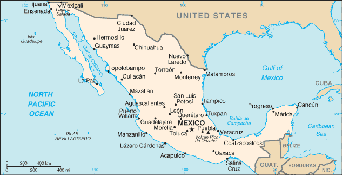
- Capital
- Mexico City
- Phone Code
- +52
- Voltage
- 127V / 60Hz
- Power Plug
- A, B
- Phone Jack
- RJ-11
- Currency
- Peso
- Dial-up
- $0.155/min
- WiFi
- $19.95/day
About connectivity in Mexico
Mexico uses 127V/60Hz with Type A and Type B outlets. The phone jack is RJ-11. Telmex (Teléfonos de México) was privatized in December 1990 in a sale to a consortium led by Carlos Slim's Grupo Carso — the foundation of what became América Móvil, eventually one of the world's largest telecom groups by subscriber count. Telmex dominated the Mexican landline market for two decades; the 2013 Federal Telecommunications Reform formally designated Telmex as a "preponderant economic agent" and imposed asymmetric regulations to open competition. AT&T Mexico, Telcel (the América Móvil mobile brand), and Movistar Mexico (Telefónica) compete in mobile and broadband.
Mexico's academic RTN network opened the country's first international Internet connection from ITESM (Instituto Tecnológico de Estudios Superiores de Monterrey) in 1989. Commercial dial-up began in 1994-1995 with Telmex/Prodigy Internet (unrelated to the US Prodigy — this was the Telmex consumer brand), Avantel (the Banamex-MCI joint venture), and Alestra (the AT&T-Grupo Alfa joint venture), alongside a long list of regional ISPs. Per-minute metered dial-up through Telmex PSTN dominated the late 1990s. Telmex's Prodigy Infinitum ADSL service launched in 2001 and quickly displaced consumer dial-up across the metropolitan areas. Cable broadband from Cablevisión (now Izzi Telecom) competed across the 2000s. The post-2013 reform brought aggressive new investment from AT&T Mexico and altnet fiber operators.
Telmex introduced its Ladatel chip-based cardphone system in 1989, making Mexico an early chip-card adopter following France's 1984 lead. Ladatel cards were issued in standard denominations and the blue-and-white Ladatel cardphone kiosks were ubiquitous across Mexican cities, towns, and rural plazas through the 1990s and 2000s. The Telmex commemorative Ladatel collector market developed substantially with thousands of distinct designs commissioned over three decades. The Mexican outbound prepaid international calling-card market was enormous — reflecting the world's largest single bilateral migration corridor between Mexico and the United States, with an estimated 12+ million Mexican-born residents in the US at peak. Dozens of branded cards (IDT's Boss Revolution and others, plus a long tail of regional issuers) competed at per-minute rates for the US-to-Mexico corridor, sold through gas stations, convenience stores, and remittance kiosks on both sides of the border. Telmex Ladatel cardphone fleets were decommissioned progressively through the 2010s.
Tempest Telecom served Mexico through dial-up POPs in Mexico City, Guadalajara, Monterrey, Tijuana, and Cancún. Mexico was a particularly important corridor for North American business travel — the US-Mexico border-region business communities used Tempest's roaming dial-up heavily through the 1990s and 2000s. Cancún and the Riviera Maya hotel WiFi rollout was a meaningful $19.95/day market. Iridium satphones served Mexican maritime customers in the Pacific, Gulf, and Caribbean fisheries, plus archaeological and remote-area expedition operators.
Modern Mexico has expanding FTTH in major cities, with mobile 4G LTE essentially universal in populated areas. 5G rollout from Telcel, AT&T Mexico, and Movistar is active in metro markets.
Tempest's services across Mexico, 1997–2012
Tempest Telecommunications operated international connectivity services in Mexico between 1997 and 2012 under a unified prepaid account that absorbed multiple service types onto a single customer credential. Customers in Mexico drew from the same balance for pre-paid international voice calling, RADIUS-authenticated dial-up Internet roaming, metered Wi-Fi hotspot access, Iridium satellite voice, and Inmarsat BGAN data terminals. The PATN kiosk-card clearinghouse (Tempest's TITAN kiOSK, incorporated 2000) extended the same card-and-PIN model to public Internet terminals but did not reach scale.
Iridium satellite voice was available in Mexico from approximately 2001 (post-bankruptcy relaunch). Thuraya coverage did not extend to Mexico; Inmarsat BGAN data terminals filled the broadband gap from late 2005.
Nearby countries in Americas
Haiti · Honduras · Jamaica · Martinique · Netherlands Antilles · Nicaragua · Panama · Paraguay