


Russia
Power & telecom standards in Russia
Connectivity Overview
Tempest Telecom offered dial-up internet access, WiFi hotspot access and broadband ethernet access in Russia. We also offered Iridium satellite Internet and Voice access in Russia for communications in rural areas without infrastructure.
Russia uses 220V at 50Hz. Power outlets are type C, F and telephone jacks are RJ-11.
Dial-up Internet Access
Tempest Telecom provided local dial-up access numbers in Russia at $0.155/minute. Travelers could connect using any standard modem with an RJ-11 telephone adapter.
WiFi Hotspot Access
Tempest Telecom provided WiFi hotspot access in Russia at $19.95/day for unlimited browsing.
Adapters & Power
Travelers from North America will need a power plug adapter. European Type C/F adapters are widely compatible.
Standard RJ-11 jacks are used. Most international modems will connect without an adapter.
Russia at a Glance
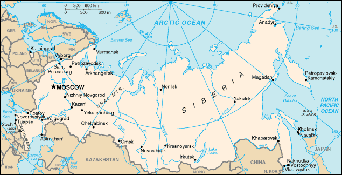
- Capital
- Moscow
- Phone Code
- +7
- Voltage
- 220V / 50Hz
- Power Plug
- C, F
- Phone Jack
- RJ-11
- Currency
- Ruble
- Dial-up
- $0.155/min
- WiFi
- $19.95/day
About connectivity in Russia
Russia uses 220V/50Hz with Type C and Type F outlets, consistent with European norms. The phone jack is RJ-11 in modern installations. Rostelecom — the post-Soviet successor to the USSR Ministry of Communications and the long-distance operator Sviazinvest — remains the dominant fixed-line operator. The mobile market is led by MTS (Mobile TeleSystems), MegaFon, and Beeline (the consumer brand of VimpelCom).
Russia's networking history is genuinely unusual. RELCOM, a UNIX-based cooperative network, made the first international IP connection from the Soviet Union to the global Internet in August 1990 — predating the dissolution of the USSR. Famously, RELCOM and Demos (the Moscow-based commercial ISP that grew out of the Relcom cooperative) carried news of the August 1991 coup attempt out of Moscow when traditional broadcast channels were tightly controlled. Commercial dial-up grew through the 1990s with Demos, Glasnet, Sovam Teleport, RUNNet, and Russia Online competing against Rostelecom's own ISP offerings. Per-minute metered access through Rostelecom PSTN was the norm. The Russian broadband market accelerated through the 2000s with cable and DSL, then aggressive FTTH deployment from Rostelecom and the regional altnet operators.
Cardphone deployment in Russia followed an unusual trajectory shaped by the 1991 dissolution of the USSR. Soviet-era 2-kopeck slot payphones were rendered useless almost overnight by hyperinflation in 1992-1993, and the conversion to prepaid-card phones happened rapidly through the mid-1990s. Rostelecom and competing private brands issued chip-card and magnetic-stripe cards in standard denominations, with prolific commemorative card markets developing across the post-Soviet space. The Russian prepaid international calling-card market through the 2000s served the substantial outbound diaspora — Russian-Israeli, Russian-American (particularly Brighton Beach, Brooklyn), Russian-German (post-1991 ethnic-German Aussiedler migration), and Russian-British communities — with private card brands competing on per-destination rates. Russian payphones across the major cities were largely retired through the 2010s as mobile penetration approached saturation.
Tempest Telecom provided dial-up access in Russia through POPs in Moscow, St. Petersburg, Yekaterinburg, and other major cities. Coverage in Siberia and the Russian Far East was particularly reliant on Iridium satellite phones — the Iridium 9505A handset was a near-standard piece of kit for energy-sector and expedition crews operating beyond the reach of terrestrial mobile networks. BGAN terminals served broadcast and oil-and-gas customers in remote oblasts; Tempest's preserved Russian-language R-BGAN UT terminal user guide (one of the five languages the documentation was issued in) reflects how meaningful the Russian-speaking customer base was for the satellite-data business.
Modern Russia has solid LTE coverage in populated areas, with 5G rollout limited to major cities. Sanctions regimes from 2022 onward have complicated Western telecom equipment supply.
Tempest's services across Russia, 1997–2012
Tempest Telecommunications operated international connectivity services in Russia between 1997 and 2012 under a unified prepaid account that absorbed multiple service types onto a single customer credential. Customers in Russia drew from the same balance for pre-paid international voice calling, RADIUS-authenticated dial-up Internet roaming, metered Wi-Fi hotspot access, Iridium and Thuraya satellite voice, and Inmarsat BGAN and Thuraya data terminals. The PATN kiosk-card clearinghouse (Tempest's TITAN kiOSK, incorporated 2000) extended the same card-and-PIN model to public Internet terminals but did not reach scale.
Both Iridium (global LEO) and Thuraya (regional GEO) satellite voice were available in Russia from approximately 2001, alongside global BGAN data from late 2005.
Nearby countries in Europe
Norway · Poland · Portugal · Romania · Serbia and Montenegro · Slovakia · Slovenia · Spain