


Uruguay
Power & telecom standards in Uruguay
Connectivity Overview
Tempest Telecom offered dial-up internet access, WiFi hotspot access and broadband ethernet access in Uruguay. We also offered Iridium satellite Internet and Voice access in Uruguay for communications in rural areas without infrastructure.
Uruguay uses 220V at 50Hz. Power outlets are type C, F, I, L and telephone jacks are RJ-11.
Dial-up Internet Access
Tempest Telecom provided local dial-up access numbers in Uruguay at $0.155/minute. Travelers could connect using any standard modem with an RJ-11 telephone adapter.
WiFi Hotspot Access
Tempest Telecom provided WiFi hotspot access in Uruguay at $19.95/day for unlimited browsing.
Adapters & Power
Travelers from North America will need a power plug adapter. European Type C/F adapters are widely compatible.
Standard RJ-11 jacks are used. Most international modems will connect without an adapter.
Uruguay at a Glance
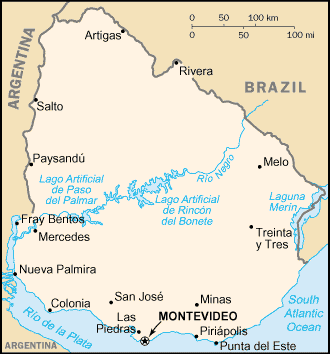
- Capital
- Montevideo
- Phone Code
- +598
- Voltage
- 220V / 50Hz
- Power Plug
- C, F, I, L
- Phone Jack
- RJ-11
- Currency
- Peso
- Dial-up
- $0.155/min
- WiFi
- $19.95/day
About connectivity in Uruguay
Uruguay uses 220V/50Hz with Type C, Type F, Type I, and Type L outlets — an unusual four-type mix reflecting layered European (Type C/F/L from Italian influence), Argentine (Type I), and modern installations. The phone jack is RJ-11. ANTEL (Administración Nacional de Telecomunicaciones), the state-owned monopoly fixed-line operator, holds an unusual position in the regional landscape — Uruguay has resisted the broader Latin American privatization wave and ANTEL has retained state ownership through the country's political transitions. Movistar Uruguay (Telefónica) and Claro Uruguay (América Móvil) compete in mobile.
Uruguayan commercial Internet emerged in 1995-1996 through ANTEL and a small number of private ISPs. Per-minute metered dial-up through ANTEL PSTN dominated the late 1990s. ANTEL's ADSL service rolled out from 2001-2002. Uruguay has consistently ranked among the more digitally-developed Latin American economies; the country's 2007 Plan Ceibal (one of the world's most aggressive one-laptop-per-child national programs) and subsequent ANTEL Vera fiber rollout drove broadband-penetration gains through the 2010s.
ANTEL introduced cardphone units in the 1990s with chip-card cardphones becoming standard. The Uruguayan prepaid international calling-card market through the 2000s and 2010s served the substantial Uruguayan outbound diaspora — concentrated in Argentina (the historic and cultural neighbor, with deep family and economic ties across the Río de la Plata), Spain, the United States, Brazil, and Italy. The country's small population (~3.4 million) made the diaspora relationship proportionally significant; the 2002 financial crisis triggered a meaningful emigration wave that sustained calling-card volume through the 2000s.
Tempest Telecom served Uruguay through dial-up POPs in Montevideo. Iridium satphones served the Atlantic-coast maritime industry (the Punta del Este tourism corridor and Montevideo port operations), agricultural-sector customers across the broader pampas region, and the small but meaningful Río de la Plata cross-border logistics customer base.
Modern Uruguay has near-universal FTTH coverage from ANTEL Vera — the country is consistently ranked at or near the top of Latin American broadband markets. Mobile 4G LTE coverage is mature nationally and 5G rollout began in 2019 (one of the earliest in Latin America).
Tempest's services across Uruguay, 1997–2012
Tempest Telecommunications operated international connectivity services in Uruguay between 1997 and 2012 under a unified prepaid account that absorbed multiple service types onto a single customer credential. Customers in Uruguay drew from the same balance for pre-paid international voice calling, RADIUS-authenticated dial-up Internet roaming, metered Wi-Fi hotspot access, Iridium satellite voice, and Inmarsat BGAN data terminals. The PATN kiosk-card clearinghouse (Tempest's TITAN kiOSK, incorporated 2000) extended the same card-and-PIN model to public Internet terminals but did not reach scale.
Iridium satellite voice was available in Uruguay from approximately 2001 (post-bankruptcy relaunch). Thuraya coverage did not extend to Uruguay; Inmarsat BGAN data terminals filled the broadband gap from late 2005.
Nearby countries in Americas
Paraguay · Peru · Puerto Rico · Suriname · Trinidad and Tobago · Turks and Caicos Islands · United States · Venezuela