


Peru
Power & telecom standards in Peru
Connectivity Overview
Tempest Telecom offered dial-up internet access, WiFi hotspot access and broadband ethernet access in Peru. We also offered Iridium satellite Internet and Voice access in Peru for communications in rural areas without infrastructure.
Peru uses 220V at 60Hz. Power outlets are type A, B, C and telephone jacks are RJ-11.
Dial-up Internet Access
Tempest Telecom provided local dial-up access numbers in Peru at $0.155/minute. Travelers could connect using any standard modem with an RJ-11 telephone adapter.
WiFi Hotspot Access
Tempest Telecom provided WiFi hotspot access in Peru at $19.95/day for unlimited browsing.
Adapters & Power
North American (Type A/B) plugs are compatible. An adapter may not be needed for US travelers.
Standard RJ-11 jacks are used. Most international modems will connect without an adapter.
Peru at a Glance
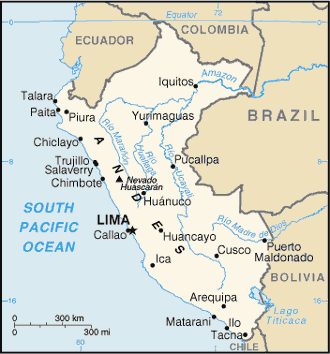
- Capital
- Lima
- Phone Code
- +51
- Voltage
- 220V / 60Hz
- Power Plug
- A, B, C
- Phone Jack
- RJ-11
- Currency
- Sol
- Dial-up
- $0.155/min
- WiFi
- $19.95/day
About connectivity in Peru
Peru uses 220V/60Hz with Type A, Type B, and Type C outlets. The phone jack is RJ-11. Telefónica del Perú, the post-1994 successor to the state CPT/Entel Perú operations following Telefónica de España's acquisition, dominated Peruvian fixed-line telecom for two decades; the company exited Peru in 2023 in a sale to Argentine Integra Capital, with the consumer brand Movistar transitioning out of operations. Claro Perú (América Móvil), Entel Perú (the former Bolivian operator, no relation to the historic Peruvian state Entel), and Bitel (Vietnamese Viettel) compete in mobile.
Peru's Red Científica Peruana (RCP) opened the country's first international Internet connection in 1991. Commercial dial-up emerged through 1994-1996 with Telefónica's consumer ISP, RCP, IBM Internet Peru, and a long list of regional providers. Per-minute metered dial-up through Telefónica del Perú PSTN dominated the late 1990s. Telefónica's Speedy ADSL service rolled out from 2001-2002 and broadband adoption accelerated through the mid-2000s. Mobile data and 4G LTE have driven most of the country's Internet-access growth since the 2010s.
Telefónica del Perú introduced cardphone units in the mid-1990s with chip-card cardphones becoming standard. The Peruvian prepaid international calling-card market through the 1990s and 2000s served the substantial outbound Peruvian diaspora — Peruvian-American (concentrated in the New York Metropolitan Area, particularly Paterson NJ and the Tri-state, plus Los Angeles, Miami, and the DC Metropolitan Area), Peruvian-Spanish (Madrid and Barcelona host the largest Peruvian populations in Europe), Peruvian-Argentine, Peruvian-Chilean, Peruvian-Italian (Milan and Turin), and Peruvian-Japanese (a long-standing community dating to early-20th-century migration). Cardphone fleets across Lima, Arequipa, Trujillo, and Cusco have been progressively decommissioned through the 2010s.
Tempest Telecom served Peru through dial-up POPs in Lima, Arequipa, Cusco, and Trujillo. Iridium satphones served the Amazonian operations (Iquitos and the broader Loreto region), the Andean expedition customer base around Cusco and the Inca Trail, the maritime fishing industry along the Pacific coast, and the energy-sector customer base in the southern desert.
Modern Peru has expanding FTTH in Lima and the regional capitals, with mobile 4G LTE essentially universal in populated areas. 5G rollout is active in metro markets.
Tempest's services across Peru, 1997–2012
Tempest Telecommunications operated international connectivity services in Peru between 1997 and 2012 under a unified prepaid account that absorbed multiple service types onto a single customer credential. Customers in Peru drew from the same balance for pre-paid international voice calling, RADIUS-authenticated dial-up Internet roaming, metered Wi-Fi hotspot access, Iridium satellite voice, and Inmarsat BGAN data terminals. The PATN kiosk-card clearinghouse (Tempest's TITAN kiOSK, incorporated 2000) extended the same card-and-PIN model to public Internet terminals but did not reach scale.
Iridium satellite voice was available in Peru from approximately 2001 (post-bankruptcy relaunch). Thuraya coverage did not extend to Peru; Inmarsat BGAN data terminals filled the broadband gap from late 2005.
Nearby countries in Americas
Netherlands Antilles · Nicaragua · Panama · Paraguay · Puerto Rico · Suriname · Trinidad and Tobago · Turks and Caicos Islands