


Venezuela
Power & telecom standards in Venezuela
Connectivity Overview
Tempest Telecom offered dial-up internet access, WiFi hotspot access and broadband ethernet access in Venezuela. We also offered Iridium satellite Internet and Voice access in Venezuela for communications in rural areas without infrastructure.
Venezuela uses 120V at 60Hz. Power outlets are type A, B and telephone jacks are RJ-11.
Dial-up Internet Access
Tempest Telecom provided local dial-up access numbers in Venezuela at $0.155/minute. Travelers could connect using any standard modem with an RJ-11 telephone adapter.
WiFi Hotspot Access
Tempest Telecom provided WiFi hotspot access in Venezuela at $19.95/day for unlimited browsing.
Adapters & Power
North American (Type A/B) plugs are compatible. An adapter may not be needed for US travelers.
Standard RJ-11 jacks are used. Most international modems will connect without an adapter.
Venezuela at a Glance
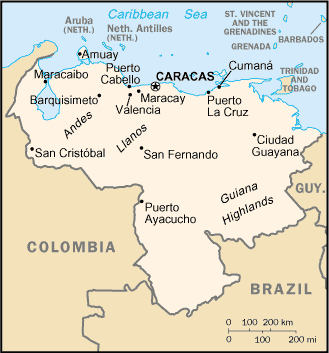
- Capital
- Caracas
- Phone Code
- +58
- Voltage
- 120V / 60Hz
- Power Plug
- A, B
- Phone Jack
- RJ-11
- Currency
- Bolivar
- Dial-up
- $0.155/min
- WiFi
- $19.95/day
About connectivity in Venezuela
Venezuela uses 120V/60Hz with Type A and Type B outlets — the North American standard. The phone jack is RJ-11. CANTV (Compañía Anónima Nacional Teléfonos de Venezuela), founded in 1930 and historically state-controlled (with a privatization-then-renationalization arc from 1991 to 2007), holds the dominant fixed-line position. Movistar Venezuela (Telefónica), Digitel, and Movilnet (the CANTV mobile subsidiary) compete in mobile and broadband. The country's severe and prolonged economic crisis from the mid-2010s onward has constrained telecom infrastructure investment substantially.
Venezuelan commercial Internet emerged in 1995-1996 through CANTV's consumer service and several regional ISPs. Per-minute metered dial-up dominated the late 1990s. ADSL rollout from CANTV/Movistar began in 2002-2003 and broadband adoption accelerated through the mid-2000s during the country's pre-crisis economic strength. From 2014 onward, hyperinflation, equipment-import restrictions, US sanctions, and infrastructure deterioration have substantially degraded Venezuelan Internet quality and access; the country's broadband-speed rankings have fallen sharply since the mid-2010s. Periodic government-imposed Internet shutdowns during political crises have further constrained access.
CANTV introduced cardphone units in the 1990s with chip-card cardphones becoming standard. The Venezuelan prepaid international calling-card market through the 1990s and 2000s was relatively modest under conditions of historically low outbound migration. From 2014 onward, the country's economic crisis triggered the largest South American emigration wave in modern history — an estimated 7+ million Venezuelans have left the country since 2015 (one of the largest displacement crises globally outside active conflict zones), concentrated in Colombia (the largest single destination, hosting 2.5-3 million Venezuelans), Peru, Chile, Ecuador, Argentina, Brazil, the United States (Miami and Houston), and Spain. The displacement-era prepaid calling-card market through the late 2010s and 2020s has been enormous in proportion to the country's population.
Tempest Telecom served Venezuela through dial-up POPs in Caracas and Maracaibo. Iridium satphones served the oil-and-gas sector (Venezuela holds the world's largest proven oil reserves; Lake Maracaibo and the Orinoco Belt operations sustained substantial satellite-voice and BGAN data customer demand), the Amazonian operations across the southern states, and the Caribbean maritime industry.
Modern Venezuela has degraded telecom infrastructure relative to historic peer economies due to the post-2014 crisis. Mobile data and partial 4G LTE coverage continue, though service quality varies widely by region. Recovery and reinvestment depend substantially on the trajectory of the broader economic and political crisis.
Tempest's services across Venezuela, 1997–2012
Tempest Telecommunications operated international connectivity services in Venezuela between 1997 and 2012 under a unified prepaid account that absorbed multiple service types onto a single customer credential. Customers in Venezuela drew from the same balance for pre-paid international voice calling, RADIUS-authenticated dial-up Internet roaming, metered Wi-Fi hotspot access, Iridium satellite voice, and Inmarsat BGAN data terminals. The PATN kiosk-card clearinghouse (Tempest's TITAN kiOSK, incorporated 2000) extended the same card-and-PIN model to public Internet terminals but did not reach scale.
Iridium satellite voice was available in Venezuela from approximately 2001 (post-bankruptcy relaunch). Thuraya coverage did not extend to Venezuela; Inmarsat BGAN data terminals filled the broadband gap from late 2005.
Nearby countries in Americas
Anguilla · Antigua and Barbuda · Argentina · Aruba · Bahamas · Barbados · Belize · Bermuda