

Satellite Phones: the consumer era 1998-2012
The consumer satellite-phone era began with Iridium's November 1998 commercial launch and effectively closed with the 2007-2012 universal-mobile-data displacement of personal-purchase satellite phones for most use cases. In that roughly 14-year window, Iridium 9500 and 9505 / 9505A handsets, Thuraya regional units, and Globalstar handsets reached the hands of expedition operators, broadcast journalists, maritime industries, oil-and-gas crews, missionary and humanitarian field workers, and the individual service members who carried personal satellite phones into Afghanistan and Iraq through the 2001-2011 war years.
Tempest Telecommunications was an Iridium service provider and Thuraya partner through this period, reselling handsets and airtime under the unified Tempest roaming account. This page documents the broader market history of consumer satellite voice and Tempest's specific operations within it.
The original Iridium SSC was a Motorola-led consortium that built and launched a 66-satellite low-Earth-orbit constellation between 1997 and 1998 for an estimated $5+ billion in total capital expenditure. The constellation's technical achievement was real and remains the foundation of the current Iridium business: cross-linked LEO satellites in polar orbit, true 100% planetary coverage including both poles, and end-to-end voice and data routing without dependence on ground gateways for the satellite hops.
The commercial launch in November 1998 was a near-immediate disaster. Iridium handsets retailed at $3,000-$5,000; airtime was $7 per minute; the original handsets were the size of a brick and required line-of-sight to the sky. The competing AT&T and other mobile carriers, which had been the original Iridium consumer-base thesis (business travelers who would carry an Iridium handset for global voice coverage), simply expanded international GSM roaming on much cheaper handsets across 1997-1999, undercutting the Iridium consumer case before it had reached scale. Less than a year after launch, Iridium SSC filed for Chapter 11 bankruptcy in August 1999.
The Iridium constellation was acquired out of bankruptcy in late 2000-early 2001 by a new ownership consortium for approximately $25 million — less than half of 1% of the original capital cost. The new operators, supported by a US Department of Defense long-term contract that effectively underwrote ongoing operations, were able to offer Iridium services at substantially lower pricing than the pre-bankruptcy Iridium SSC could sustain. Handsets retailed from approximately $1,200-$1,800 in the post-bankruptcy era; airtime came down to $1-$2 per minute through service- provider channels.
At those revised price points, personal-purchase Iridium handsets became practical for the customer bases that had always actually wanted them — expedition operators, journalists, maritime crews, mission stations, and individual service members — the customer base that the pre-bankruptcy Iridium business plan had misidentified as a secondary niche.
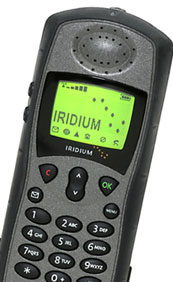
The Motorola-built Iridium 9500 was the original 1998 handset: large, heavy (approximately 460g without battery), brick-shaped. The 9505 launched in 2001 with substantial redesign — smaller (approximately 375g), more durable, water-and-shock resistant per IP54 standards, with 21-language prompt support and a headset jack. The 9505A (2005-2006) added GPS positioning, longer battery life, and improved signal handling.
Through the 2002-2010 core operational period, the 9505 and 9505A were the standard consumer Iridium handsets. Both supported voice (up to 3.2 hours talk time, 30 hours standby), SMS messaging, and basic data via an RS-232 adapter at approximately 2.4 kbps. The data rate was nearly useless for general Internet but adequate for short situational-report emails and position reporting.
Tempest sold the 9505 and 9505A through the consumer-era period under purchase and rental options. Rental was the dominant model for short-trip customers (expedition teams, single-event broadcast crews, individual travelers heading off-grid for a few weeks); purchase was the standard for sustained-deployment customers (mission stations, oil-and-gas operations, maritime fleets, government deployments).
Iridium and Thuraya handset deployments through the operational era spanned multiple customer verticals documented in the Solutions section. The mission and humanitarian customer base (aid organizations — Christian missionary networks, UN agencies, ICRC, MSF) made Iridium the standard issue for field personnel. The oil-and-gas and mineral sector used Iridium as the personnel-safety standard at remote-extraction operations. Broadcast journalists deployed Iridium as the voice-supplement to BGAN data terminals at conflict-zone and disaster-response sites. Individual self-funded customers (Pacific-crossing sailors, mountaineering expeditions, polar travelers) made up the long-tail consumer segment. Construction and engineering EPC contractors included Iridium in standard issue for rotation crews working remote-site projects.
The Iridium 9505/9505A consumer-era customer base that Tempest served across 2001-2012 spanned several distinct segments:
- Mission and religious organizations: Christian missionary and humanitarian organizations operating in remote African, Asian, and Latin American field sites were among the most consistent Iridium customers through the period. The combination of true global coverage including remote tropical interiors, personnel-safety value for kidnap-and-rescue protocols, and predictable monthly airtime budgets made Iridium the right fit for the segment.
- Maritime industry: Yacht owners, commercial fishing fleets, and supply-vessel maritime operators in the offshore oil-and-gas sector standardized on Iridium voice supplementing the larger BGAN data terminals.
- Expedition and outdoor: Polar expeditions, Himalayan climbing operations, ocean-crossing sailors, Antarctic research, and the broader adventure-travel customer base.
- Oil and gas: Personnel-safety standard at remote land and offshore operations; the major operators (BP, Shell, Chevron, ExxonMobil, Total, Eni, Aramco) included Iridium handsets in standard issue for field personnel.
- Individual servicepeople and contractors: Through the 2003-2011 US-led operations in Iraq and Afghanistan, a substantial number of personnel carried personally-purchased Iridium handsets as backup communications. The military supplied its own communications kit; personal Iridium phones supplemented for personal calls home and as redundancy when military networks were operationally constrained.
- Broadcast and journalism: Foreign correspondents in conflict zones, natural-disaster response, and remote-location coverage. Iridium voice was the conversational supplement to the BGAN data terminals that transmitted the recorded content.
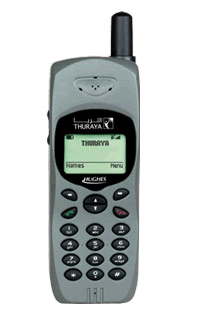
Thuraya, headquartered in Abu Dhabi, launched its first satellite in 2000 and its commercial service in 2001 with a novel hybrid product: a dual-mode handset that worked as a regular GSM phone in terrestrial-coverage areas and automatically switched to satellite mode when GSM was unavailable. Coverage spanned approximately one-third of the planet — all of Europe, Africa, the Middle East, Central and South Asia.
For customers operating exclusively within the Thuraya footprint, the dual-mode capability was a meaningful advantage over Iridium — the same handset worked as a normal phone in cities and as a satellite phone in remote regions, without carrying separate devices. Thuraya hardware (the Hughes 7100 and 7101 handsets through the early-to-mid 2000s) was substantially cheaper than Iridium hardware and the airtime was competitive.
Thuraya was the right choice for customers whose satellite-coverage need was entirely within the footprint — African NGO operations, Middle Eastern oil and gas, expedition operators working the Saharan or Central Asian deserts. For customers requiring genuine global coverage (Antarctica, the Pacific, the Americas outside the southwestern US edge of the footprint), Iridium remained the only option.
Tempest sold Thuraya alongside Iridium, with the customer's choice driven by coverage requirements and budget. Many customers carried both: a Thuraya for the regional-coverage convenience of dual-mode operation, and an Iridium for backup and for any travel outside the Thuraya footprint.
Globalstar, the third major consumer-satellite-phone competitor of the era, launched its 48-satellite LEO constellation in 1999-2000. Globalstar coverage was geographic but not truly global — the bent-pipe satellite architecture required ground gateways for the satellite hops, which meant gaps in coverage across the open oceans and over countries without licensed ground stations. Globalstar entered its own Chapter 11 in 2002, was acquired by Thermo Capital Partners, and continued operations through the 2000s with the original constellation slowly degrading. Globalstar captured a niche position with the SPOT satellite messengers (introduced 2007) as a consumer-recreation product but didn't reach Iridium's scale in the professional-customer market.
The consumer-satellite-phone-handset market contracted significantly from 2008-2012 onward as smartphones with international roaming displaced the use cases that had sustained satphone purchases for business travelers and lower-intensity remote-area workers. Iridium's subsequent products kept the professional-customer base loyal — the Iridium 9555 (2008) and 9575 Extreme (2011) were modern handset evolutions; the Iridium Certus broadband platform from 2018-2019 onward replaced the legacy data services with substantially higher throughput.
Parallel categories emerged: Garmin inReach satellite-messenger devices (consumer- recreation use), Apple iPhone-14-onward emergency satellite SOS messaging (mass- market everyday phones), and the post-2021 SpaceX Starlink consumer broadband terminals (data not voice, but in many use cases substituting for the data-side of satellite-phone purposes). The 1998-2012 era of dedicated consumer satellite handsets exists today as a specific historical period — the foundational era when satellite voice for individuals first became economically practical.