

Western Sahara
Power & telecom standards in Western Sahara
Connectivity Overview
Tempest Telecom offered satellite-only service in Western Sahara. Iridium satellite Internet and Voice access was available for communications in rural areas without infrastructure.
Western Sahara uses 220V at 50Hz. Power outlets are type C, E and telephone jacks are RJ-11.
Dial-up Internet Access
Dial-up access was not available in Western Sahara. Satellite Internet was the recommended alternative.
WiFi Hotspot Access
WiFi hotspot access was not available through Tempest in Western Sahara.
Adapters & Power
Travelers from North America will need a power plug adapter. European Type C/F adapters are widely compatible.
Standard RJ-11 jacks are used. Most international modems will connect without an adapter.
Western Sahara at a Glance
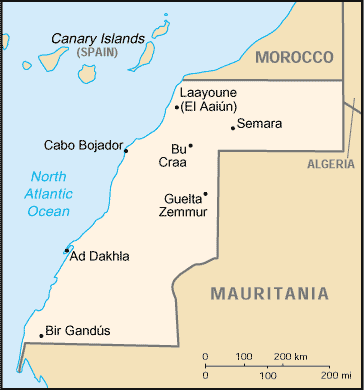
- Capital
- El Aaiun
- Phone Code
- +212
- Voltage
- 220V / 50Hz
- Power Plug
- C, E
- Phone Jack
- RJ-11
- Currency
- Moroccan Dirham
- Dial-up
- N/A
- WiFi
- N/A
About connectivity in Western Sahara
Western Sahara uses 220V/50Hz with the French/European Type C and Type E outlets — consistent with the broader North African standard. The phone jack is RJ-11. The territory uses the Moroccan country code +212, the Moroccan Dirham as currency, and operates under telecommunications infrastructure provided by Maroc Telecom and Inwi in the Moroccan-administered areas. The Polisario-administered areas (the small inland portion controlled by the Sahrawi Arab Democratic Republic) operate under separate and limited connectivity arrangements.
Western Sahara is a disputed territory: most of the territory has been under Moroccan administration since the 1975-1979 Western Sahara War, with Polisario controlling the eastern interior. Internet and mobile telecom coverage in the Moroccan-administered areas reflects the broader Moroccan commercial market. The Tindouf-based Sahrawi refugee camps in Algeria have separate connectivity arrangements typically funded through humanitarian programs.
Tempest Telecom served Western Sahara through Iridium and Thuraya satellite phones primarily — Thuraya's GEO regional coverage extends across the territory, making it operationally significant for journalists and humanitarian operators working the Sahrawi-camp customer base, MINURSO (the UN Mission for the Referendum in Western Sahara, operational since 1991), and phosphate-industry workers at the Bou Craa mine.
Modern Western Sahara has expanding 4G LTE coverage in the principal Moroccan-administered settlements (Laayoune, Dakhla); the Polisario-administered areas remain substantially less connected.
Tempest's services across Western Sahara, 1997–2012
Tempest Telecommunications operated international connectivity services in Western Sahara between 1997 and 2012 under a unified prepaid account that absorbed multiple service types onto a single customer credential. Customers in Western Sahara drew from the same balance for pre-paid international voice calling, RADIUS-authenticated dial-up Internet roaming, metered Wi-Fi hotspot access, Iridium satellite voice, and Inmarsat BGAN data terminals. The PATN kiosk-card clearinghouse (Tempest's TITAN kiOSK, incorporated 2000) extended the same card-and-PIN model to public Internet terminals but did not reach scale.
Iridium satellite voice was available in Western Sahara from approximately 2001 (post-bankruptcy relaunch). Thuraya coverage did not extend to Western Sahara; Inmarsat BGAN data terminals filled the broadband gap from late 2005.