


Korea - DPR
Power & telecom standards in Korea - DPR
Connectivity Overview
Tempest Telecom offered satellite-only service in Korea - DPR. Iridium satellite Internet and Voice access was available for communications in rural areas without infrastructure.
Korea - DPR uses 220V at 60Hz. Power outlets are type C, F and telephone jacks are RJ-11.
Dial-up Internet Access
Dial-up access was not available in Korea - DPR. Satellite Internet was the recommended alternative.
WiFi Hotspot Access
WiFi hotspot access was not available through Tempest in Korea - DPR.
Adapters & Power
Travelers from North America will need a power plug adapter. European Type C/F adapters are widely compatible.
Standard RJ-11 jacks are used. Most international modems will connect without an adapter.
Korea - DPR at a Glance
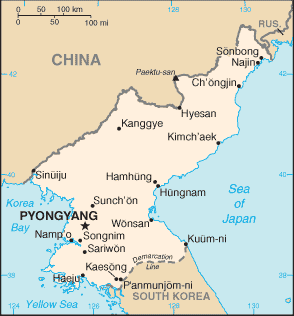
- Capital
- Pyongyang
- Phone Code
- +850
- Voltage
- 220V / 60Hz
- Power Plug
- C, F
- Phone Jack
- RJ-11
- Currency
- Won
- Dial-up
- N/A
- WiFi
- N/A
About connectivity in Korea - DPR
North Korea uses 220V/60Hz (an unusual frequency combination) with Type C and Type F outlets. The phone jack is RJ-11 in modern infrastructure. The Korea Posts and Telecommunications Corporation (KPTC) holds the state telecom monopoly. Orascom Telecom (Egypt) launched the Koryolink 3G mobile network in 2008 in joint venture with KPTC; the joint-venture relationship has been contested across multiple disputes since 2015.
Public Internet access in North Korea is essentially non-existent for the general population. The state operates the closed Kwangmyong intranet for domestic content. International Internet access is restricted to senior officials, foreign embassies, foreign business representatives, and selected tourist hotels. The international gateway has historically run through Chinese carriers.
Tempest Telecom did not operate dial-up or satellite services accessible to North Korean residents during the company's 1997-2012 operational period. International journalists, diplomatic personnel, and NGO workers traveling into North Korea on monitored visits were the only operational customer category, and primarily through Iridium satellite handsets brought in by visitors (subject to North Korean customs restrictions that frequently confiscated such equipment).
Modern North Korea has 3G mobile in major cities; international call and data access remains tightly controlled.
Tempest's services across Korea - DPR, 1997–2012
Tempest Telecommunications operated international connectivity services in Korea - DPR between 1997 and 2012 under a unified prepaid account that absorbed multiple service types onto a single customer credential. Customers in Korea - DPR drew from the same balance for pre-paid international voice calling, RADIUS-authenticated dial-up Internet roaming, metered Wi-Fi hotspot access, Iridium satellite voice, and Inmarsat BGAN data terminals. The PATN kiosk-card clearinghouse (Tempest's TITAN kiOSK, incorporated 2000) extended the same card-and-PIN model to public Internet terminals but did not reach scale.
Iridium satellite voice was available in Korea - DPR from approximately 2001 (post-bankruptcy relaunch). Thuraya coverage did not extend to Korea - DPR; Inmarsat BGAN data terminals filled the broadband gap from late 2005.