

The TITAN Global Communications Card was the consumer-facing instrument of the unified prepaid platform that Tempest Telecommunications operated between 1997 and the early 2010s. A single wallet-sized card, carrying a single account number and a single PIN, gave a traveller access to four distinct services printed directly on its face: international toll-free long distance, international dial-up Internet access, international Internet kiosk access, and international cyber-cafe access. Every one of those services drew from the same prepaid balance. The card is a surviving primary-source artifact of an architecture that several earlier pages in this archive describe from the platform side: one credential, many heterogeneous networks, one balance.
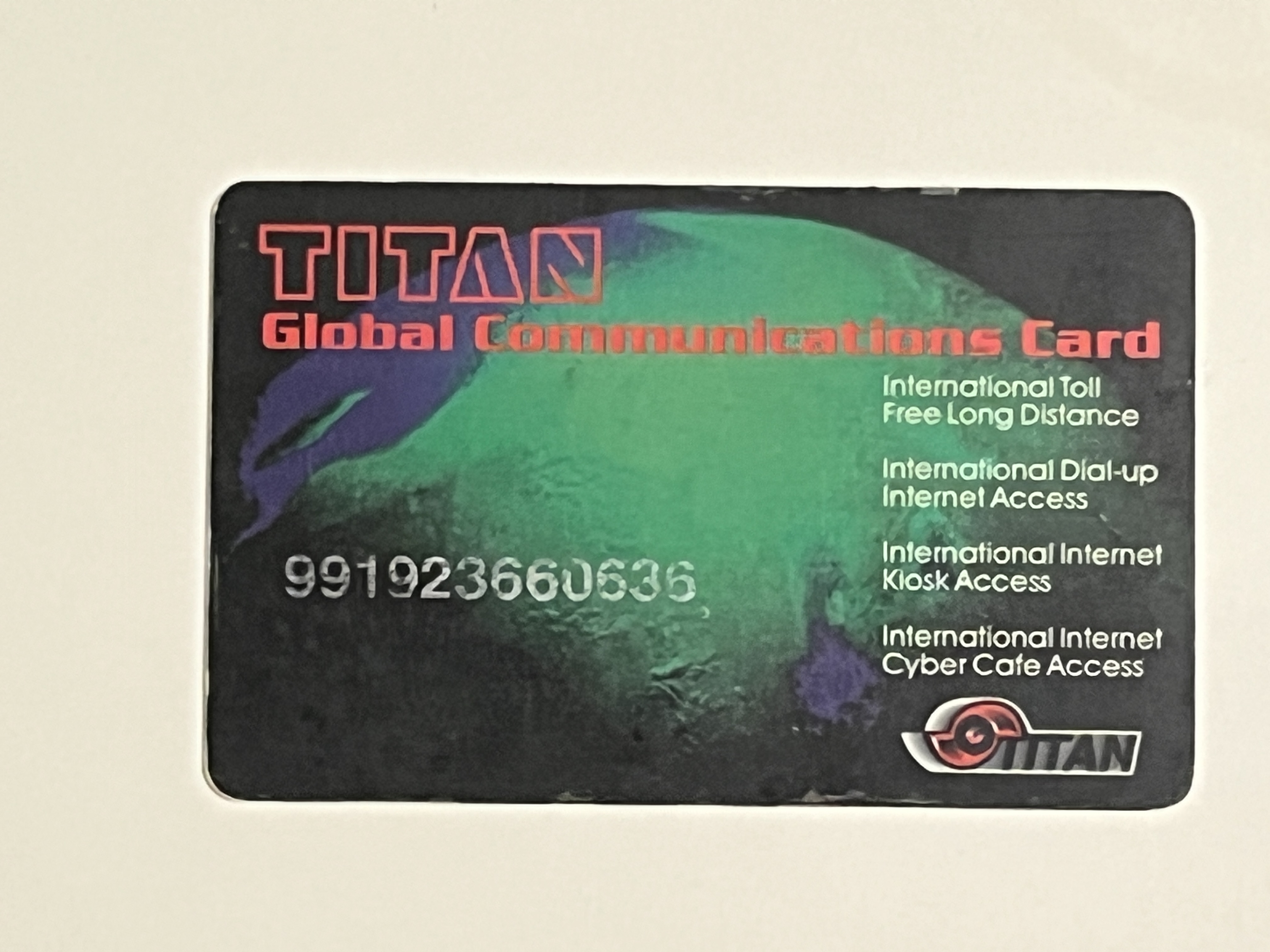
The four services printed on the card
The card's front lists its four capabilities in plain language, and each maps to a leg of the platform that the rest of this archive documents in detail:
- International Toll Free Long Distance. The PSTN voice leg: an IVR-validated prepaid calling card of the kind that dominated the post-deregulation late-1990s market. This is the calling-card half of the 1997 combined product.
- International Dial-up Internet Access. The data leg: PPP dial-up sessions authenticated against the same account through Tempest's 1997 RADIUS roaming deployment, using the card number as the username and the PIN as the password.
- International Internet Kiosk Access. Walk-up access at public Internet terminals, authenticated by swiping the card and entering the PIN. This is the consumer side of PATN (Public Access Terminal Networks), the Internet-kiosk card clearinghouse that began as Tempest's TITAN kiOSK product and was incorporated as its own company in 2000, with Tempest as its first card issuer.
- International Internet Cyber Cafe Access. Session access at staffed cyber-cafe workstations, where the customer presented the card and the attendant applied the session against the balance.
The significance is the combination, not any single line. Two parallel industries (prepaid voice and prepaid Internet access) and two physical access modalities (the customer's own dialling device and someone else's public terminal) sat on one instrument with one balance. The card is the artifact that makes the unified-platform claim concrete: the four services are not a retrospective description, they are printed on the product a customer actually carried.
One PIN, two ways to present it
The reverse of the card carries the usage directions, and they reveal a design detail that the platform-side pages cannot: the TITAN card was a dual-modality credential. For the two services the customer reached from their own device, the card number and PIN were keyed in. For the two services delivered through a third party's hardware, the card itself was physically presented.
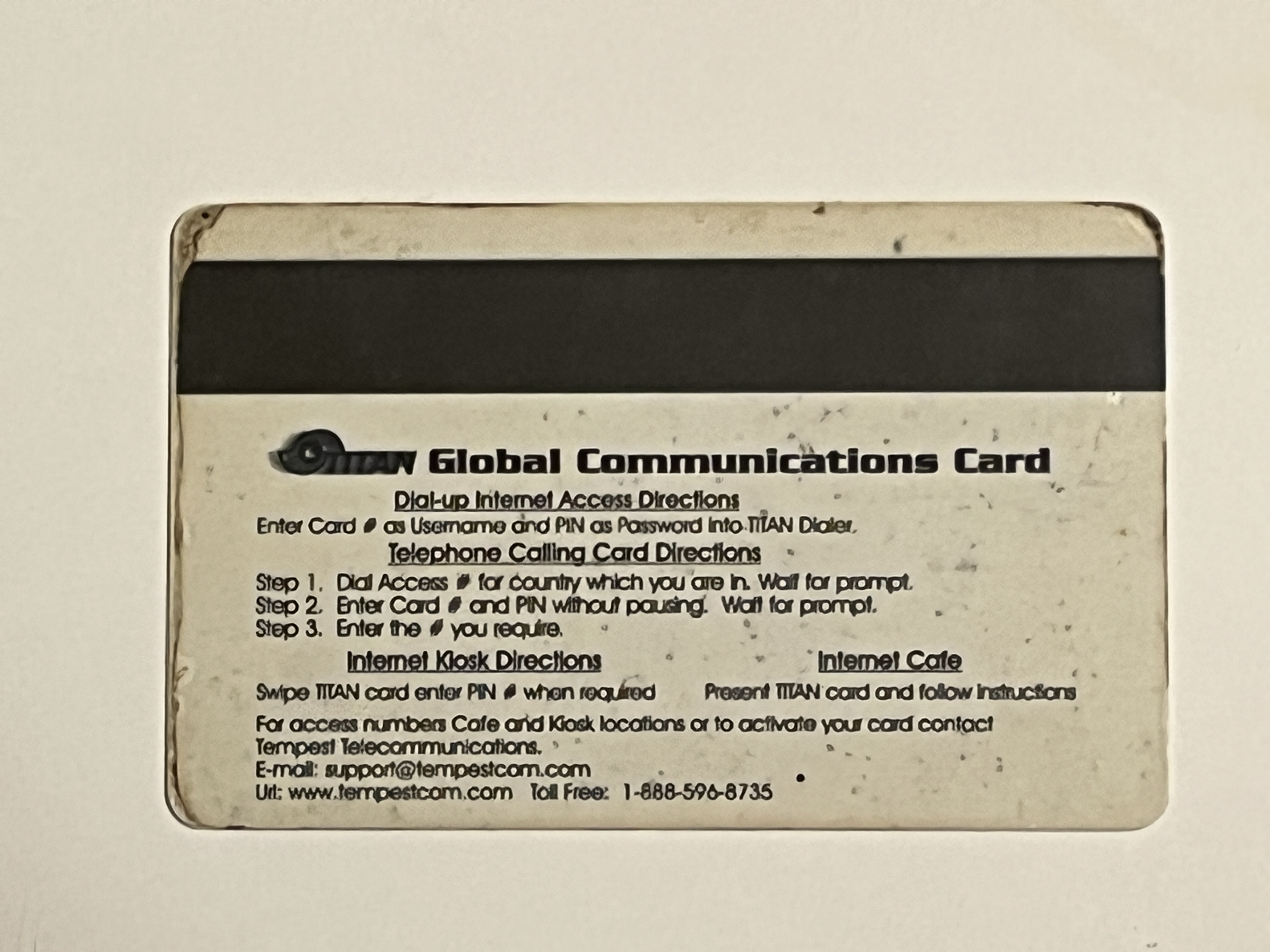
- Dial-up Internet access: the directions instruct the customer to enter the card number as the username and the PIN as the password into the "TITAN Dialer." That dialler is the bundled connection client, and copies of the dial-up software (the "TitanDialx" package) survive in this site's historical download archive.
- Telephone calling card: a three-step IVR flow. Dial the in-country access number, wait for the prompt, enter the card number and PIN without pausing, then enter the destination number. Standard prepaid-card mechanics for the period.
- Internet kiosk: swipe the card and enter the PIN when prompted. The magnetic stripe visible on the reverse is what made the swipe flow possible at unattended terminals.
- Cyber cafe: present the card to the attendant and follow instructions. The staffed-counter equivalent of the kiosk swipe.
The card directs customers to Tempest Telecommunications for access numbers, cafe and kiosk locations, and activation, and lists the company's support email, the tempestcom.com web address, and a toll-free number. Those are the contemporaneous contact channels of the operator, printed on the product, which is part of what makes the artifact useful as documentation rather than reconstruction.
The kiosk and cyber-cafe tier
The kiosk and cyber-cafe lines are the part of the card with the most company history behind them. The kiosk product began inside Tempest as TITAN kiOSK and was rebranded Public Access Terminal Networks (PATN) while still running on Tempest's infrastructure, then incorporated as its own company in March 2000. PATN was a neutral clearinghouse for Internet-kiosk access cards, handling real-time authentication, accounting, and per-minute settlement between card issuers and the independent operators of public terminals, on the model of credit-card interchange and ATM networks. Tempest was PATN's first card issuer, and the only one listed on PATN's card-holder page, under a hopeful "More Coming Soon."
The TITAN card is the consumer surface of that clearinghouse. The "International Internet Kiosk Access" and "International Internet Cyber Cafe Access" lines, the magnetic stripe, and the swipe-and-PIN directions on the reverse are what a PATN-issued card looked like in a cardholder's wallet. The kiosk used an unattended swipe-and-PIN flow, the cyber-cafe a present-the-card flow at a staffed counter, and both routed back to the same Tempest account and the same balance as the card's voice and dial-up services.
PATN never reached scale. It incorporated the month the Nasdaq peaked and spent its life inside the dot-com collapse, while home broadband, the laptop, and the smartphone were deleting the shared public terminal it depended on. The full account of the clearinghouse and why it failed is documented separately. For dating the card, the presence of live, named kiosk and cyber-cafe services places the TITAN card in the PATN window of roughly 2000 to 2003, when the unified platform was at its widest service footprint, before the consumer markets for prepaid voice, dial-up, and public terminals collapsed in the smartphone transition.
The card as primary source
Most of the unified-platform documentation in this archive rests on the operator's own account of how the system was built. The TITAN card adds a contemporaneous physical artifact to that record. Three details on it are independently corroborating. The four printed service lines match the four legs of the platform documented from the architecture side. The dial-up directions name the "TITAN Dialer," and the matching connection software is preserved in this site's download archive. The reverse pairs a magnetic stripe with explicit swipe directions, confirming that the kiosk flow was a physical-card flow rather than a keyed-PIN flow, a detail that the platform-side narrative does not by itself establish.
The card does not, on its own, date itself precisely or prove the "first to combine voice and Internet on one balance" claim that the 1997 product page makes with its own caveats. What it does is convert the unified-balance description from assertion into documented product: a single instrument, four services, one balance, carried by real customers.
Part of the Tempest unified-platform architectural arc, 1997-2012. See One Account, Many Networks for the full synthesis across all eight production service types.
Sources and further reading
- One Card, Two Networks: Tempest's 1997 Combined Calling Card and Dial-Up Roaming Product (Tempest historical archive).
- TITAN, kiOSK, and PATN: One Roaming Idea, Three Machines (1996-2003) (Tempest historical archive).
- RFC 2058 in Production: How RADIUS Made ISP Roaming Possible in 1997 (Tempest historical archive).
- Wikipedia, Telephone card, Calling card (telecommunications), and Internet cafe.
This page is part of an ongoing historical archive of the 1989-2012 international telecom industry, maintained by Jason Jacoby, a former operator at Interglobe (UK phone cards) and Tempest Telecommunications. Corrections and additions welcome via the contact page.