


Hungary
Power & telecom standards in Hungary
Connectivity Overview
Tempest Telecom offered dial-up internet access, WiFi hotspot access and broadband ethernet access in Hungary. We also offered Iridium satellite Internet and Voice access in Hungary for communications in rural areas without infrastructure.
Hungary uses 230V at 50Hz. Power outlets are type C, F and telephone jacks are RJ-11.
Dial-up Internet Access
Tempest Telecom provided local dial-up access numbers in Hungary at $0.155/minute. Travelers could connect using any standard modem with an RJ-11 telephone adapter.
WiFi Hotspot Access
Tempest Telecom provided WiFi hotspot access in Hungary at $19.95/day for unlimited browsing.
Adapters & Power
Travelers from North America will need a power plug adapter. European Type C/F adapters are widely compatible.
Standard RJ-11 jacks are used. Most international modems will connect without an adapter.
Hungary at a Glance
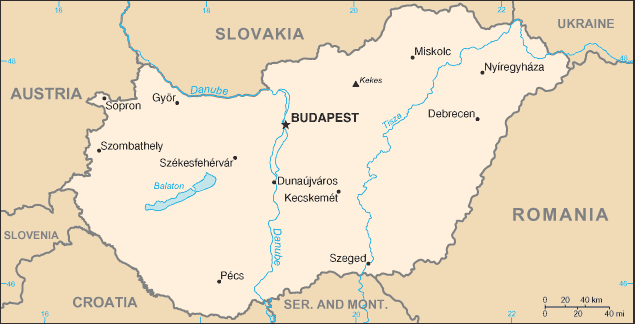
- Capital
- Budapest
- Phone Code
- +36
- Voltage
- 230V / 50Hz
- Power Plug
- C, F
- Phone Jack
- RJ-11
- Currency
- Forint
- Dial-up
- $0.155/min
- WiFi
- $19.95/day
About connectivity in Hungary
Hungary uses 230V/50Hz with Type C and Type F outlets, identical to the European mainstream. Modern installations use RJ-11; legacy buildings may retain the Hungarian PTT connector. Magyar Posta was structurally split in 1989-1990 to separate the telecommunications operator (initially MATÁV) from the postal service. Deutsche Telekom acquired a controlling stake in MATÁV from 1999 onward, rebranding to Magyar Telekom in 2005. Vodafone Hungary, Yettel (the former Telenor), and Digi compete in mobile and broadband.
Hungary's Internet history runs back to 1991 when the IIF / HUNGARNET academic network opened a connection to EARN, making Hungary one of the earliest post-Communist countries on the Internet. Commercial ISP service began in 1994 through MATÁV alongside private operators including DataNet, Euroweb, Synergon, and Pantel. Per-minute metered dial-up through MATÁV PSTN dominated the late 1990s; flat-rate plans and ADSL rolled out from 2001-2003. Consumer dial-up faded across the mid-2000s as broadband saturated Budapest and the regional county seats.
The Hungarian telefonkártya — the first Hungarian word travelers in Budapest typically encounter at the Máv station kiosks — was introduced by Magyar Posta in 1991, with rapid rollout across Budapest, Debrecen, Szeged, Pécs, and the major county seats. Magnetic-stripe cards came first, with chip-card cardphones following from the late 1990s. The post-1989 phone-card explosion across the former Warsaw Pact was particularly fast in Hungary, which had begun market reforms before the Wall fell and led the region in commercial telecom deregulation. Standard denominations and dozens of commemorative editions through three decades made Hungarian phonecard collecting a serious hobby market. Substantial prepaid international calling-card activity through the 2000s served the Hungarian diaspora to Germany, Austria, the UK, and the US, plus inbound calls from Hungarian-speaking minorities in Romania, Slovakia, Serbia, and Ukraine. The Magyar Telekom payphone fleet was almost entirely decommissioned through the 2010s.
Tempest Telecom served Hungary through dial-up POPs in Budapest and other major commercial centers. Budapest was a regional hub for Tempest's Central European business-traveler dial-up roaming through the late 1990s and 2000s; the Kéleti (Eastern) and Nyugati (Western) main rail stations were dense calling-card kiosk markets throughout this period — the post-1989 Hungarian telefonkártya boom is part of the source material for Tempest's decision to combine calling cards and dial-up roaming on a single credential in 1997. Iridium satphones served customers operating in the rural Púszta and the Tokaj/Eger wine regions outside reliable mobile coverage.
Modern Hungary has dense FTTH coverage in Budapest and the larger county seats, with rapidly expanding 5G from Magyar Telekom, Vodafone, Yettel, and Digi. The country participates in EU broadband and 5G-corridor programs.
Tempest's services across Hungary, 1997–2012
Tempest Telecommunications operated international connectivity services in Hungary between 1997 and 2012 under a unified prepaid account that absorbed multiple service types onto a single customer credential. Customers in Hungary drew from the same balance for pre-paid international voice calling, RADIUS-authenticated dial-up Internet roaming, metered Wi-Fi hotspot access, Iridium and Thuraya satellite voice, and Inmarsat BGAN and Thuraya data terminals. The PATN kiosk-card clearinghouse (Tempest's TITAN kiOSK, incorporated 2000) extended the same card-and-PIN model to public Internet terminals but did not reach scale.
Both Iridium (global LEO) and Thuraya (regional GEO) satellite voice were available in Hungary from approximately 2001, alongside global BGAN data from late 2005.
Nearby countries in Europe
France · Germany · Gibraltar · Greece · Iceland · Ireland · Italy · Latvia